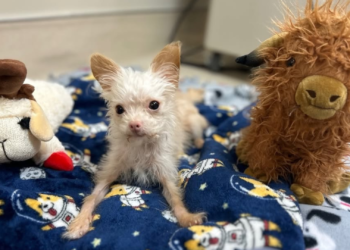

Joon was found in a cardboard box on a Queens curb on April 11, 2026. The three-year-old Maltese mix was underweight, frightened, and covered in dirty mats, according to the ASPCA’s account of her rescue.
In her intake photographs, tangled hair almost hides her eyes. Her tiny face is difficult to make out beneath the uneven coat.

Image: www.aspca.org
NYPD officers brought her to the ASPCA Animal Hospital. Staff sedated her for clipping and bathing, treated irritated skin, and carefully restored her diet.
There is something deeply moving about seeing a neglected dog receive such ordinary things: a clean coat, a meal, a place to rest. None should be remarkable. Yet a rescue photograph can make us stop and think about how much an animal depends on someone being there to provide them.

Image: www.aspca.org
Coat care has a practical purpose, too. The ASPCA explains that regular brushing helps remove dirt, distribute natural oils, and prevent tangles. The amount of attention a dog needs depends on the coat; some long-haired dogs require daily brushing.

Image: www.aspca.org
Grooming also gives caregivers an opportunity to notice the skin underneath. Redness, sores, unusual hair loss, or repeated scratching can signal a problem that deserves a veterinary examination. A dog’s appearance is only part of what a care team needs to assess.

Image: www.aspca.org
The ASPCA also notes that dirty, matted coats can make dogs more prone to painful areas of inflamed skin known as hot spots. Veterinary attention matters when a skin problem appears, because the irritation can have several possible causes. A veterinarian can determine what treatment the individual dog needs.

Image: www.aspca.org
After grooming, Joon’s eyes and the outline of her little face were easy to see.
The most satisfying transformation photographs invite us to look closely. We notice the outline of a face, the shape of an ear, the expression that was difficult to see before. They also invite a bigger question: what will life look like for this dog once the immediate care is finished?

Image: www.aspca.org
For dogs recovering from neglect, their surroundings can be part of the answer. The ASPCA Recovery & Rehabilitation Center in Pawling, New York, combines veterinary treatment with behavioral care and housing designed to reduce stress.
The center’s design gives an idea of how carefully that work is considered. Rooms contain no more than five kennels and use materials that absorb sound. Dogs have access to natural light and outdoor spaces, with places for play, exercise, and exploration.
There are also rooms arranged to resemble a home. These offer opportunities to practice skills that can help a dog prepare for adoption. A veterinary clinic on the premises provides diagnostic equipment and facilities for surgery and dental care.
The organization describes its approach as individual care: staff consider each animal’s medical needs, stress, fear, and sensitivity to handling. Those needs can affect both daily comfort and the path toward a successful adoption.
The team also works with other ASPCA programs to develop behavioral interventions and share what they learn with other shelters. The goal is to help more animals receive care suited to their needs.

Image: www.aspca.org
At Pawling, technician Kelly Lewis helped Joon progress from hiding in a crate to enjoying the grass, play, and affection.
That kind of progress is easy to overlook when a dramatic haircut is the first thing that draws us in. A rescue story is also made up of quieter moments, and they deserve room in the telling. The daily attention behind an adoption rarely fits into a single photograph.
After five weeks of rehabilitation, Joon met Christina, who was grieving the loss of her dog Benji. Joon ran toward her.
“She bolted toward me,” Christina told the ASPCA.
For anyone considering adoption, a meeting with a dog can carry a great deal of hope. It is also the beginning of getting to know an individual: their preferences, their worries, the things they enjoy, and the support they will need. There is time for that relationship to develop.

Image: www.aspca.org
Humane World for Animals’ guidance on welcoming an adopted dog emphasizes preparation and patience. Adjustment can take days, months, or longer, and a new home may feel overwhelming even when everyone in it is eager to help.
The organization recommends keeping the early days quiet and establishing predictable routines for meals and walks. A calm place to rest gives a dog somewhere to retreat while becoming familiar with the household. Busy outings and a parade of introductions can wait.
It also encourages families to agree on the practical details ahead of time: who will handle walks, when meals will happen, and where the dog will sleep. Having those decisions made lets the first days revolve around getting acquainted.
Adopters can also ask what food their dog has been eating and maintain that diet initially. Changes can be introduced gradually. These small preparations help make the transition more consistent while a family learns what works for its newest member.
Positive reinforcement is another part of that guidance. Rewarding the behaviors a family wants to encourage can help build a positive relationship as the dog settles in.
Christina adopted Joon. The ASPCA’s September update described her enjoying blankets, family company, and two canine housemates.
“Adopting her is the best decision I’ve ever made,” Christina said.