
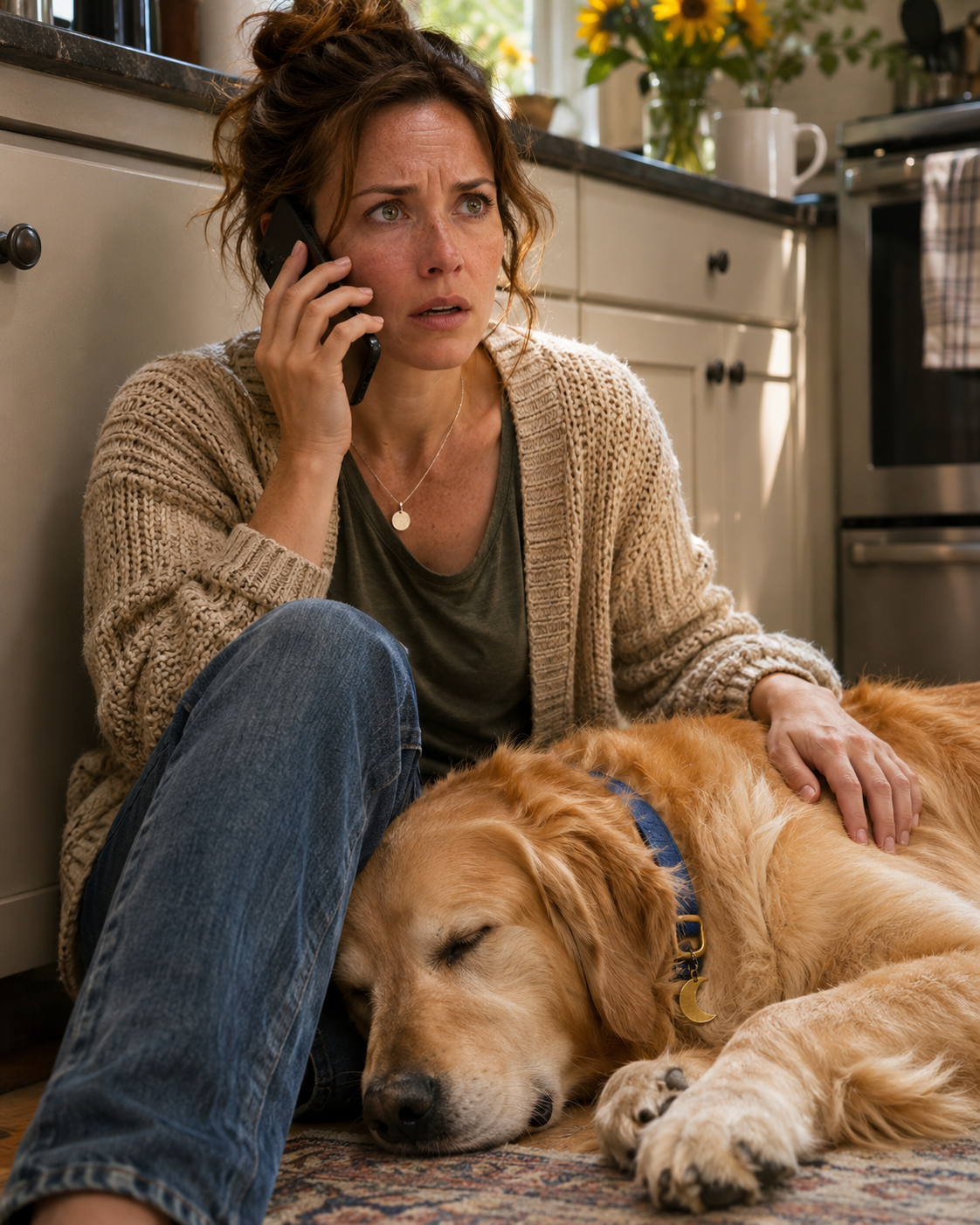
The officer said she was holding my missing dog.
I looked down at the golden retriever asleep against my leg.
“I’m sorry,” I said. “That can’t be right. He’s here.”
The dog at my feet opened one eye, thumped his tail against the kitchen cabinet, and went back to sleep. His blue collar was twisted sideways, just as it always was after a nap.
The woman on the phone was patient. She told me her name was Officer Morales and that a golden retriever had been brought to the county animal services building after being found wandering near a closed gas station. The animal had a microchip registered to me.
“His name is Archie, correct?” she asked.
My throat went dry.
“Yes.”
“And you reported him missing last spring?”
I gripped the counter. That report was eighteen months old. I’d filed it during five terrible days when Archie vanished from a boarding kennel. The kennel had eventually called to say he was safe. I’d driven over and brought him home myself.
He was the dog lying against my leg.
Or so I had believed for eighteen months.
THE POLICE HAD FOUND MY DOG. BUT THE DOG I’D BROUGHT HOME AFTER HE WENT MISSING WAS SLEEPING AT MY FEET.
The Five Days I Never Wanted to Remember
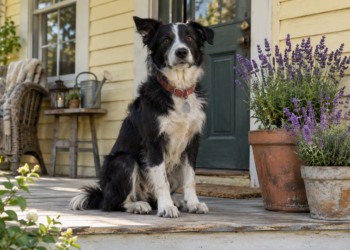
Archie was seven now, a honey-colored golden retriever with an uneven cream patch under his chin and a habit of turning every walk into a search for tennis balls.
I’d raised him from an eight-week-old puppy. He slept through my divorce, moved apartments with me twice, and somehow learned to open the pantry door with his nose. If someone asked what home felt like to me, I would have pointed to his fur all over my couch.
Eighteen months earlier, I had boarded him at Pine Hollow Pet Lodge while I traveled out of state for my mother’s surgery.
On the second night, a storm knocked out the electricity near the kennel. A service gate had been left unsecured during cleanup. One of the dogs that got out was Archie.
The manager, Colin Reeves, called me with the news. He said his employees were searching and had contacted local animal services. I flew home early and spent the next five days driving back roads with a stack of flyers on my passenger seat.
I left my number with shelters, animal hospitals, and every business near the kennel. I checked ditch lines and empty fields. Every golden-colored shape beside the road made my heart jump.
Then Colin called.
“We’ve got him,” he said. “He’s okay.”
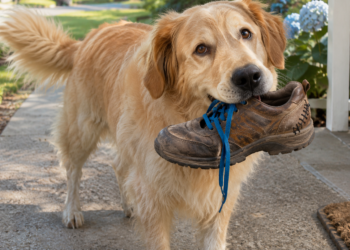
He told me a maintenance worker had spotted Archie near an irrigation canal and helped bring him back. When I arrived, the dog was waiting in the reception area wearing his familiar blue collar with the little brass moon-shaped tag.
I remember dropping to my knees.
I remember crying into his neck.
And I remember thinking he seemed strangely quiet.
The kennel manager said he’d been frightened and exhausted. That explanation made sense. For weeks afterward, I told myself the changes I noticed were just the aftereffects of being lost.
I closed the missing-dog flyers on my laptop and let myself believe the worst was over.
The Dog Who Came Home Different
Now, with Officer Morales still on the phone, I began remembering details I had pushed aside.
Archie had always slept in the living room, stretched across the rug beside the front door. After the kennel incident, he chose the narrow space beneath my kitchen window. He would stay there for hours, watching people walk past.
The old Archie would drop a tennis ball into my lap and insist I throw it until my shoulder hurt. The dog who came home from Pine Hollow chased a ball once, then lay down beside it as if he didn’t understand the game.
He liked different treats, too. He became nervous around the vacuum cleaner. He pressed his forehead against my knees when I sat down, something Archie had never done before.
I asked my veterinarian about the change. She examined him, found no obvious injury, and said stressful experiences could affect behavior. We discussed giving him time and watching for signs of pain or anxiety.
I never asked her to scan his microchip.
Why would I? He had come home wearing Archie’s collar. He answered when I called Archie. He knew where the water bowl was, and he followed me to bed every night.
I was so relieved to have him back that I interpreted every familiar detail as proof.
Now I looked at the sleeping dog and realized how much I had wanted those details to be enough.
“Could you read me the chip number?” I asked Officer Morales.
She read the last four digits: 6418.
My hands began to shake.
Those were the last four digits on Archie’s original adoption paperwork, which I still kept in a folder above the refrigerator.
The officer wasn’t calling about a similar-looking dog with the wrong phone number.
She was calling about a dog carrying Archie’s actual identification.
HE HAD ARCHIE’S COLLAR, ARCHIE’S NAME, AND A PLACE IN MY HOME. THERE WAS JUST ONE THING I’D NEVER CHECKED.
The Dog Waiting at Animal Services
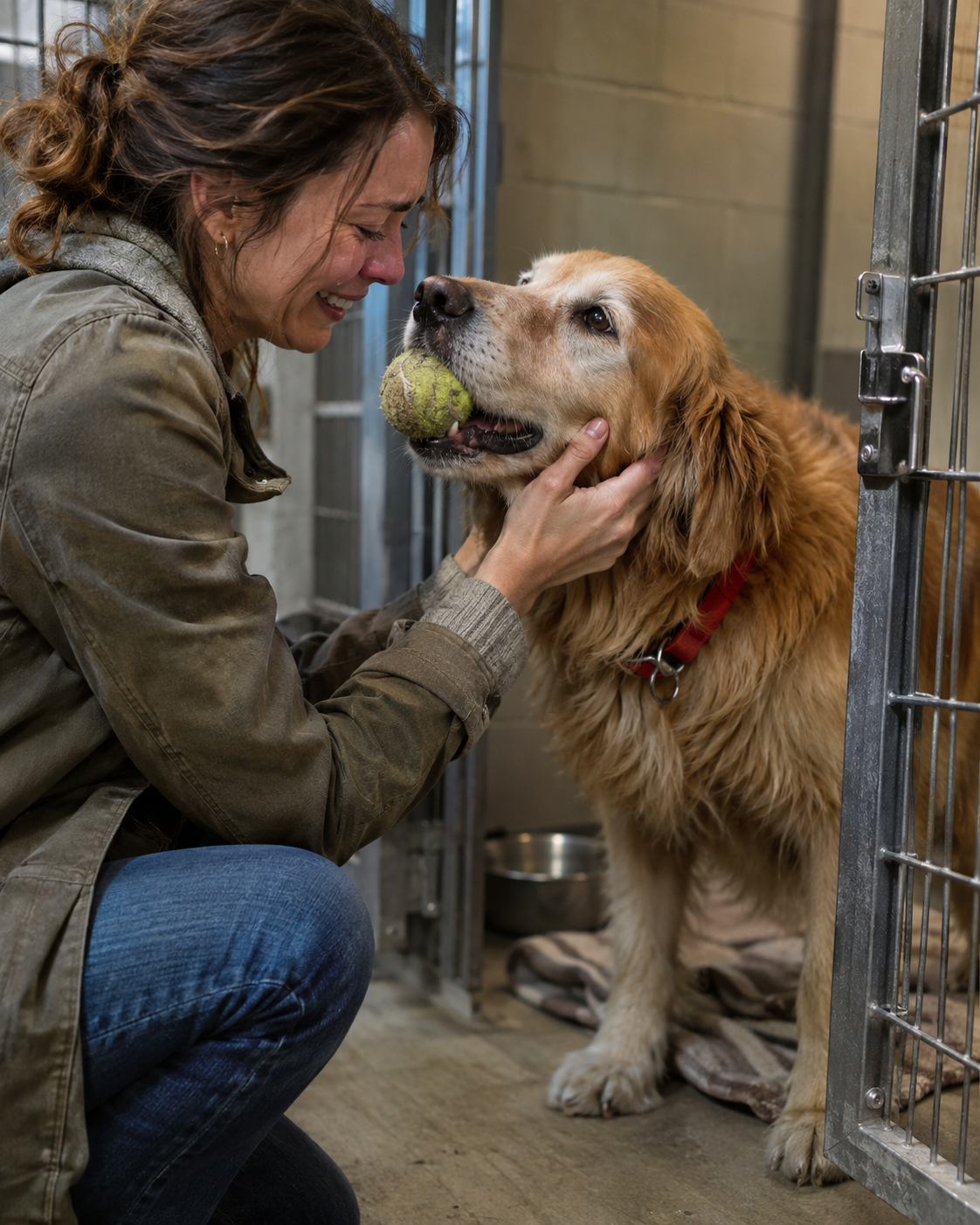
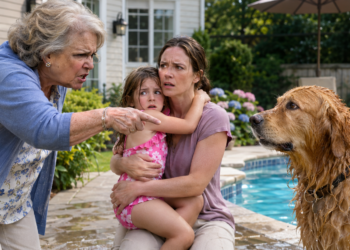
Image source: OpenAI(For illustrative purposes)
I didn’t leave the dog at home alone. My friend Rachel came over, and I asked her to sit with him while I drove to the county building.
On the way, I tried to make the call make sense. Maybe someone had copied a number incorrectly. Maybe microchips were reused. Maybe the officer had read a file belonging to a different Archie.
But when Morales met me at the front desk, she placed a printout of the scan on the counter. The number matched the original paperwork I had brought with me, digit for digit.
“We found an open lost-animal report linked to this chip,” she explained. “That’s why we called you.”
The report had never been closed in the county system, despite my private belief that Archie had been recovered.
“Can I see him?” I asked.
She took me down a short hallway. Beyond a kennel door stood another golden retriever.
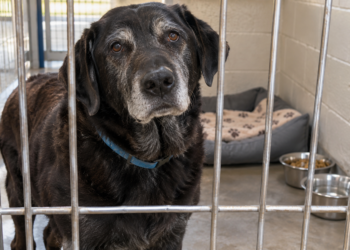
He was thinner than the dog sleeping in my kitchen, with gray beginning to gather around his muzzle. His fur was rough and uneven, and he wore a faded red collar instead of blue.
But he had the same wide-set eyes. The same dark spot on his lower lip. The same small cream-colored patch beneath his chin.
He stood perfectly still when he saw me.
I crouched, pressing one hand against the glass.
“Archie?”
His ears lifted. He took one cautious step forward.
Then he did something I hadn’t seen in eighteen months.
He picked up the rubber ball lying beside his blanket, carried it to the door, and dropped it at my feet when the attendant opened the kennel.
It was the exact impatient, ridiculous greeting Archie had given me every day for years.
I sat down on the floor, and he pushed his face into my shoulder.
For a moment, all I could do was hold him.
The joy of finding him was so sharp it almost hurt. But underneath it came another feeling I couldn’t name.
There was another dog at home who trusted me completely.
And I had no idea who he was.
Two Dogs, One Name
I brought the dog from animal services to my veterinarian that afternoon. I arranged for an examination and asked her to review the microchip record and his condition before introducing him to the dog at home.
The vet confirmed what the officer had told me: this was Archie, the dog whose chip I’d registered years earlier.
He needed dental care and a few weeks of nutritional support, but he was stable enough to come home after the initial assessment.
Then Rachel brought my other dog to the clinic.
I had known this part would be difficult. The dog had curled up on my bed that morning. He had greeted me through every hard day of the past year and a half. Whatever his history, none of that had been pretend.
He trotted through the door, saw me, and wagged with his whole body.
“Hi, sweetheart,” I whispered.
The vet ran the scanner carefully along his shoulders and neck, then across the rest of his body.
A different number appeared.
The office contacted the registry and, with my permission, helped us work through the information associated with that chip.
It was registered to a rescue organization called Cedar Valley Golden Rescue.
The name in its original records was Gus.
Gus. Not Archie.
I said the name aloud. The dog looked up at me, curious but uncertain.
Rachel put her arm around my shoulders.
“I don’t understand,” I said. “How could they give me another dog?”
The veterinarian didn’t try to guess. She told me to obtain the old kennel’s records and contact the rescue.
That evening, the two dogs stayed in separate rooms while I made calls. I couldn’t yet bring myself to put away either of their water bowls.
The Rescue’s Missing Page
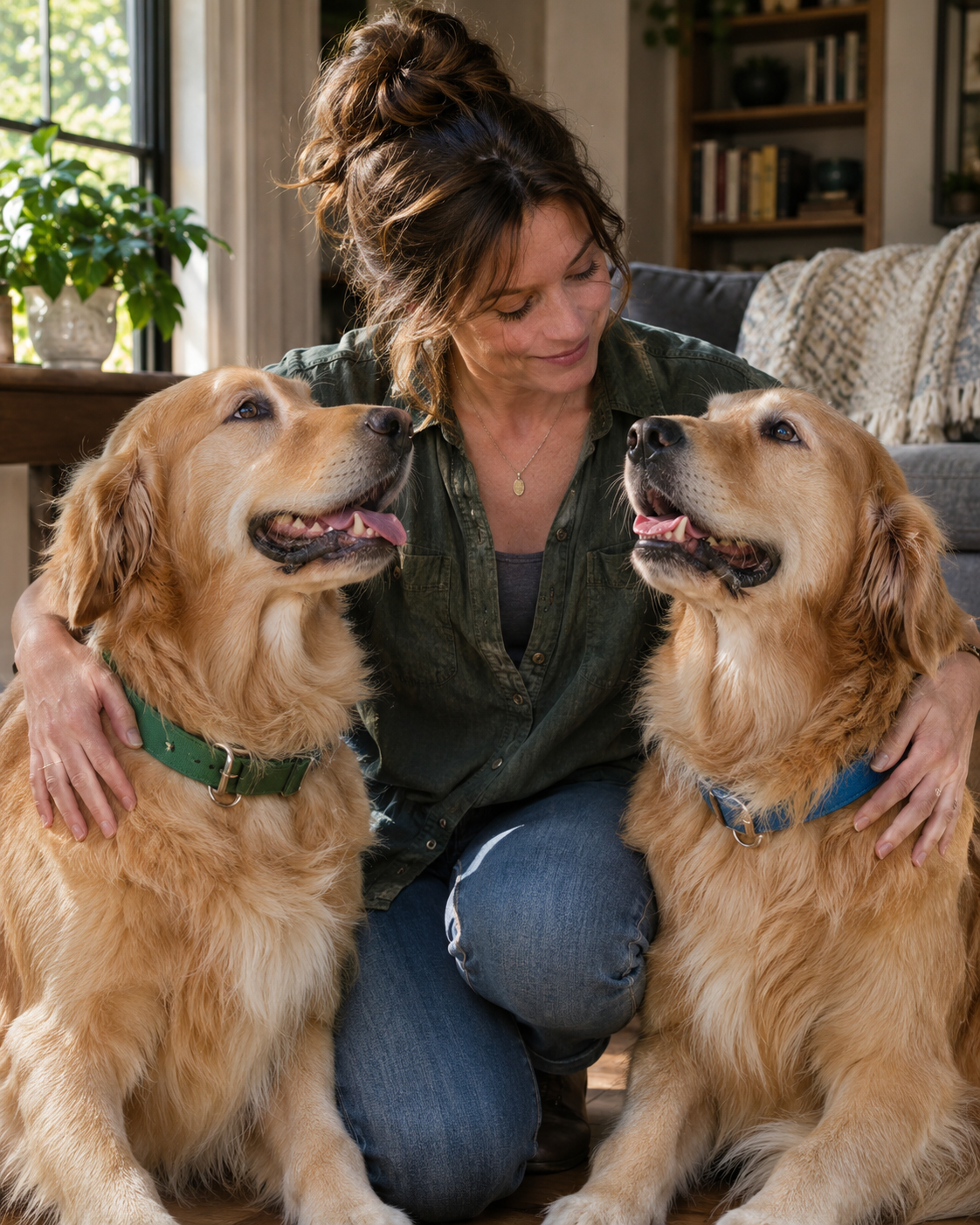
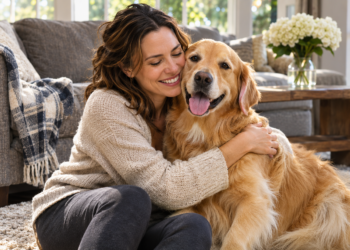
Image source: OpenAI(For illustrative purposes)
Cedar Valley’s director, a woman named Lena Brooks, returned my message the next morning.
When I gave her the chip number, she went quiet.
“We’ve been looking for him,” she said.
Not Archie. Gus.
The rescue had placed Gus at Pine Hollow Pet Lodge as a temporary boarding arrangement while it prepared a foster-home transfer. He was an adult golden retriever, estimated to be about the same age as Archie. He had been moved there only three days before the storm.
According to the rescue’s file, Gus had been transferred directly from the kennel to a permanent home. The paperwork included my name as the adopter.
“I never applied to adopt him,” I said.
Lena asked me to send a picture of the document. When I opened it, my stomach dropped. My name had been typed into the adoption field, but the signature wasn’t mine. The address was correct; the telephone number was mine; the rest of the form had been completed without my knowledge.
The rescue believed Gus had gone to an approved home. I believed my missing dog had been returned.
For eighteen months, nobody had realized those were two different stories.
Lena listened while I described the kennel’s phone call and the blue collar. Then she asked if I still had Archie’s puppy records.
“Why?”
“Because there’s something unusual about Gus’s file,” she said. “He came into rescue with a breeder transfer record. I want to compare it with what you have.”
I photographed my old purchase receipt, vaccination card, and litter information and sent them over.
Twenty minutes later, Lena called again.
“Both dogs came from the same litter,” she said.
I stared at the kitchen wall.
Archie and Gus weren’t just two similar-looking golden retrievers.
They were brothers.
The same breeder had placed Archie with me as a puppy. Gus had gone to another home and, years later, entered rescue after his family could no longer care for him.
Suddenly their almost identical faces and the ease with which I had mistaken one for the other made a little more sense.
It didn’t explain who had switched them.
But it explained why the switch had worked.
THE DOG WHO CAME HOME AFTER ARCHIE DISAPPEARED WASN’T A STRANGER. HE WAS ARCHIE’S BROTHER.
What Happened at Pine Hollow
Pine Hollow had closed six months earlier. Its website was gone, and the phone number on my receipt led to a disconnected line.
Lena still had copies of the rescue’s old emails. A former kennel employee named Hannah had been copied on the correspondence, and she agreed to speak with me after I explained what we’d discovered.
“I remember those two dogs,” she said immediately.
She told me the lodge had been chaotic after the storm. The power failure had affected the kennel doors, several employees couldn’t get in because of flooding, and staff members were working double shifts.
Archie escaped during the cleanup. Gus, the rescue dog, remained in a secured run.
By the fifth day, Colin, the manager, was facing increasingly angry calls from me and questions from the rescue about when Gus could be transferred.
Hannah said she had seen Colin place Gus in the reception room with Archie’s blue collar and tag.
“I asked him why he was doing that,” she told me. “He said you’d recognize your own dog and that I should stop interfering.”
She hadn’t seen the actual handoff. But she remembered Gus no longer being at the kennel the next morning, and a transfer record being sent to the rescue with my name on it.
“Why didn’t you tell anyone?” I asked.
There was a long silence.
“I should have,” Hannah said. “I was nineteen, and I was afraid of losing my job. That’s not an excuse.”
I didn’t know what to say. I had imagined some complicated, unavoidable mistake. What she described sounded like a decision made because someone wanted the problem to disappear.
I gave the officer the documents and the names of the people willing to speak about the old records. I also sent copies to the rescue. I wasn’t interested in guessing what authorities would decide, but I wanted the facts on record.
Colin didn’t answer the message I sent to the last email address I had for him.
I could never recover those eighteen months with Archie.
And I couldn’t stop thinking about the other question: where had my real dog been all that time?
The Man Who Called Him Sunday
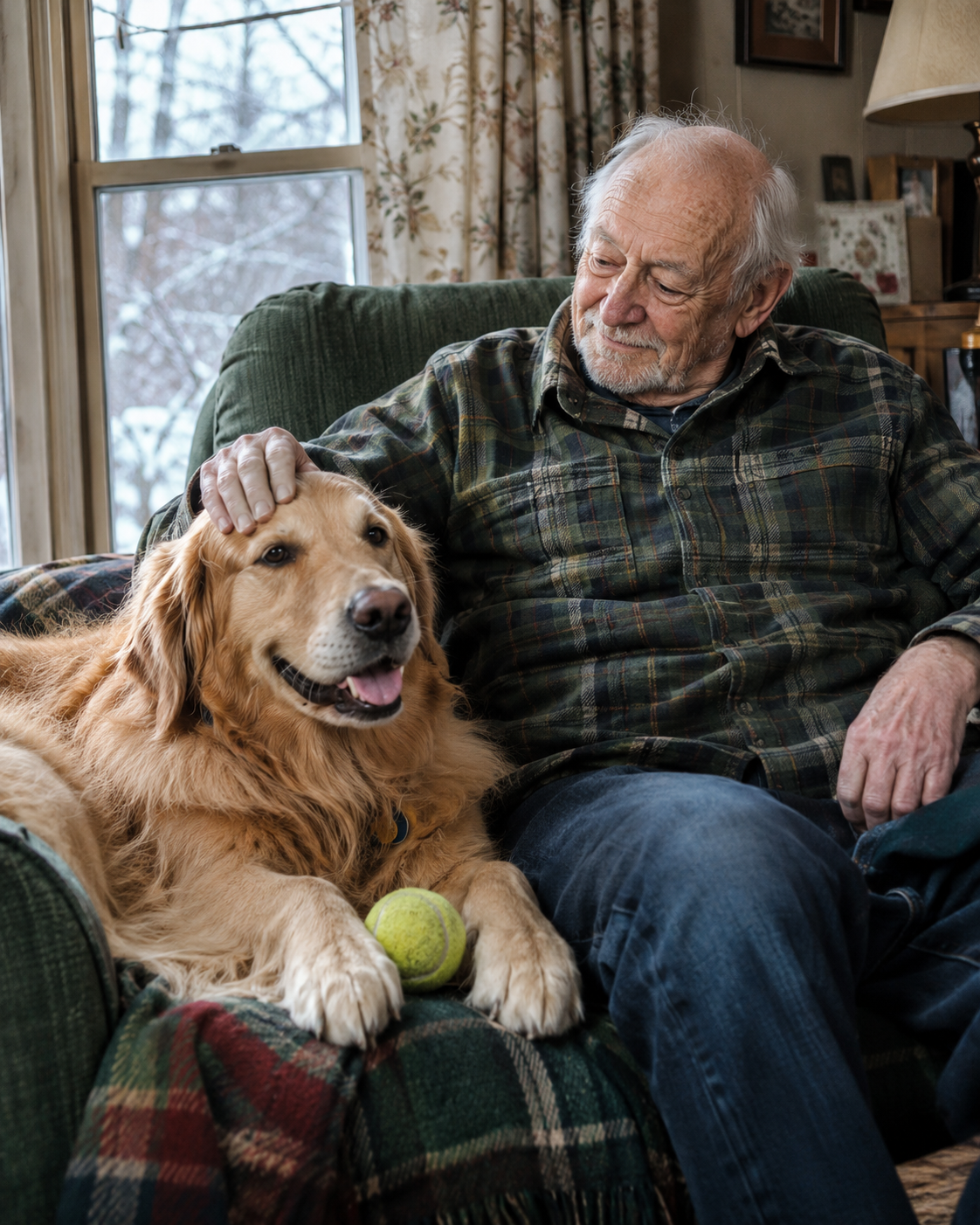
Image source: OpenAI(For illustrative purposes)
Officer Morales helped connect me with the woman who had brought Archie in after he was found near the gas station.
Her name was Mrs. Ortega. She explained that her elderly neighbor, Mr. Ellis, had been caring for a golden retriever he called Sunday for more than a year.
The dog had appeared near his property after a storm. Mr. Ellis had provided food, shelter, and companionship. According to Mrs. Ortega, he had thought he’d found an abandoned dog and didn’t know to ask for a microchip scan.
He wasn’t a cruel man, she emphasized. He was mostly homebound and had grown deeply attached to Sunday. After he was hospitalized, relatives arranged help at the house, and the dog slipped out through a side door during the confusion.
Mrs. Ortega found him two streets away and called for assistance. That was how the microchip had finally been checked.
She sent me a photograph from the previous winter.
Archie—my Archie—was lying beside an elderly man in a green armchair. A tennis ball rested between his paws. The man had one hand on his head, and both of them looked completely content.
I cried when I saw it.
I’d spent eighteen months picturing Archie alone somewhere, cold and frightened. Learning that someone had cared for him didn’t erase what happened, but it gave me back a piece of peace I hadn’t expected.
I asked Mrs. Ortega whether I could write to Mr. Ellis.
She said she’d make sure he received the letter.
I thanked him for taking Archie in, told him the name Archie had carried before he became Sunday, and enclosed a new photograph. I promised to send updates if he wanted them.
Then I sat beside Gus on the kitchen floor and told him about it, although he couldn’t possibly understand the words.
He rested his chin on my knee.
For the first time since the officer’s call, I began to see a path forward that didn’t require losing either dog.
The Choice Nobody Had Prepared Me For
Lena explained that Gus’s rescue had never intended to place him without an approved adoption process. Once she had reviewed the documentation and spoken with the rescue’s board, she asked whether I wanted to apply to adopt him properly.
I said yes before she’d finished the question.
Then I looked at the two dogs through the baby gate I’d installed across the hallway.
Archie was on one side, waiting with a tennis ball at his feet. Gus was on the other, sleeping in the familiar curled position he’d chosen at my house for eighteen months.
I loved Archie with the fierce ache of having lost him once.
I loved Gus with the quieter certainty of all the ordinary mornings we’d shared.
A Slow Introduction
They were brothers, but they hadn’t lived together since they were puppies. I didn’t assume they’d be best friends simply because they were related.
With advice from the veterinarian and a trainer, I began introducing them gradually. We took separate walks first, then parallel walks with Rachel helping. We gave each dog a place to rest, ate their meals separately, and watched their body language instead of forcing them together for a picture.
Some days they barely acknowledged one another. Other days Archie carried a ball past Gus, who watched with mild curiosity before settling back down.
Gus kept the blue collar he’d come home in. Archie wore a new green one.
I struggled with their names. Gus had answered to Archie for a year and a half, and the real Archie still knew his name. So I began calling the dog at home Gus in a warm, encouraging voice, pairing it with the little routines he already loved. Slowly, he started turning toward it.
A few weeks later, I caught myself saying, “Come on, boys,” and watched both dogs rise to follow me.
It was the smallest moment.
It made me cry anyway.
I’D SPENT EIGHTEEN MONTHS LOVING THE WRONG DOG UNDER THE RIGHT NAME. BUT THERE WAS NOTHING WRONG ABOUT LOVING HIM.
Two Bowls by the Kitchen Window
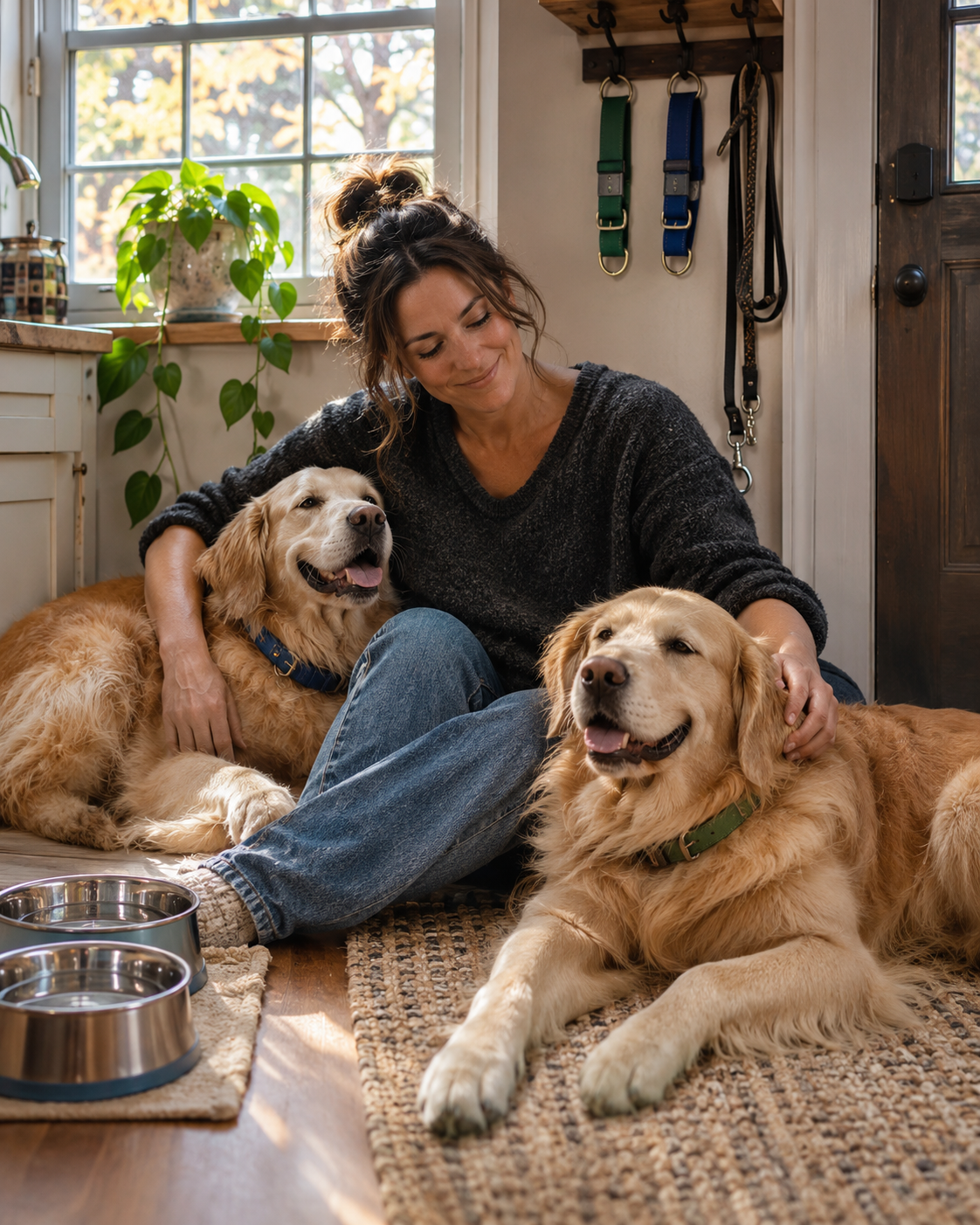
Image source: OpenAI(For illustrative purposes)
The rescue completed Gus’s adoption after the paperwork was reviewed. Archie regained his health gradually, and the county updated his missing-dog record to show that he’d been found.
Lena was still helping me document what had happened with Pine Hollow. I didn’t know if anyone would ever fully explain the manager’s decision. I knew only that Gus had not chosen any of it, and neither had Archie.
On a Sunday morning, I took both dogs into the backyard after breakfast.
Archie found his tennis ball in the grass and dropped it at my feet. Gus ambled over, sniffed it once, and walked away to examine the fence line. They were almost identical when they stood together, but now I couldn’t imagine confusing them.
Archie was loud, impatient, and always ready to run.
Gus was thoughtful and gentle, happiest when he could find a sunny patch of floor and keep one eye on me.
When we came back inside, they settled in the kitchen while I made coffee. Gus took his usual place beneath the window. Archie stretched across the rug by the door.
Two dogs. Two bowls. Two collars hanging on hooks beside the leash rack.
My phone buzzed with a message from Mrs. Ortega. Mr. Ellis had received my letter. He wanted me to know he’d always called Archie a very good boy and was glad he was safe.
I showed Archie the photo of the man in the green armchair, and he pressed his nose against my hand.
Gus came over too, wondering why I was sitting on the floor.
For a while, I simply stayed there with both of them.
I’d spent months believing the story of my missing dog had a happy ending. Then one phone call told me the ending I’d trusted wasn’t true.
But the truth hadn’t taken the dog I’d loved away from me.
It had brought another one home.
An original fictional story. The characters and events are invented.