
The first night Walter spent in my house, he refused to eat his dinner.
He didn’t bark. He didn’t growl. He didn’t knock anything over.
The thirteen-year-old Labrador mix simply stood beside his full bowl, staring at the empty space to its left.
Then he did something I couldn’t explain.
He picked up the spare stainless-steel bowl I’d left near the kitchen cabinet, carried it slowly across the floor, and dropped it next to his own.
He waited.
When nothing happened, he lay down between the two bowls and rested his gray muzzle on his paws.
I thought it was one more strange habit that had convinced three families to return him to the animal shelter.
Two weeks later, I would learn that Walter had been waiting for someone the entire time.
And that the people who’d brought him to the shelter had left out the one detail that could have explained almost everything.
THREE FAMILIES THOUGHT WALTER WAS TOO DIFFICULT TO KEEP. NOBODY HAD ASKED WHO HE WAS WAITING FOR.
The Dog Nobody Wanted to Take Home Again
I’d gone to the shelter looking for an older dog.
My house was quiet, my workdays were predictable, and I had no interest in raising a puppy who needed constant entertainment. I wanted a companion who would be happy with slow walks and a comfortable place to sleep.
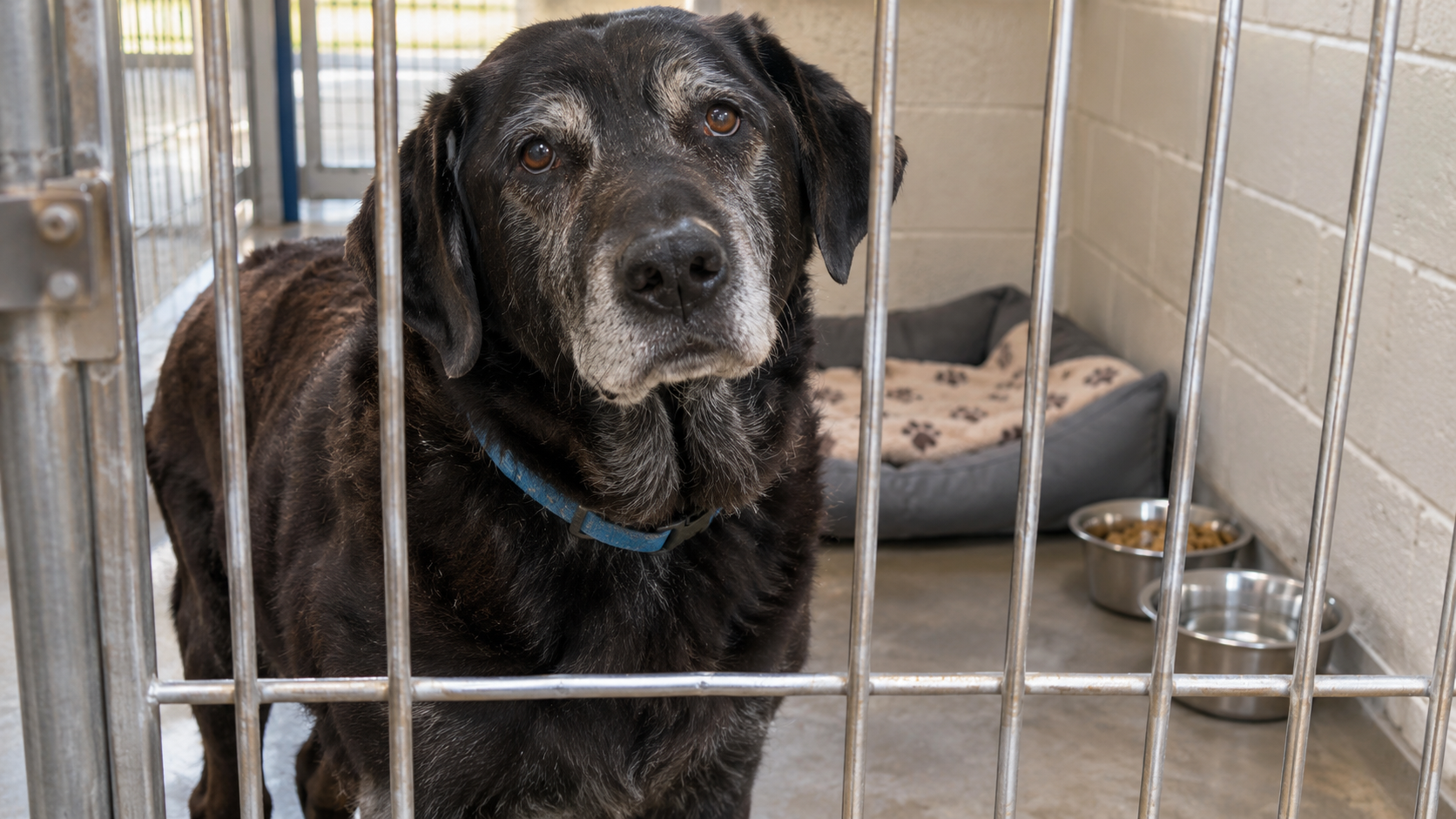
Walter was lying on a thin blanket at the back of his kennel when I saw him.
He was mostly black, with a white patch on his chest and so much silver around his eyes that he looked as though someone had dusted his face with flour. His hind legs were stiff when he stood, but his tail gave one careful wag when I crouched beside the door.
A staff member named Nina stopped next to me.
“He’s thirteen,” she said. “And before you ask, yes, he’s been adopted before.”
She held a clipboard against her chest.
“Three times since he came here. All three families brought him back.”
The first couple had returned him after nine days because he paced every evening and wouldn’t settle at night.
The second family said he barely touched his food and spent hours watching their front door.
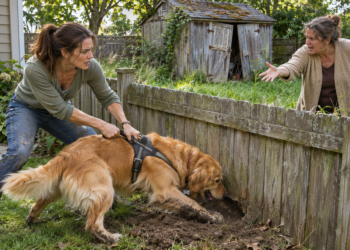
The third had kept him for less than a week. Walter scratched at their patio door, dragged his bedding into the hallway, and whined whenever they closed him in a separate room.
No one had reported aggression. He hadn’t bitten anyone, destroyed furniture, or shown any interest in running away once he was outdoors.
But the comments on his record grew shorter each time.
Too anxious.
Doesn’t adjust.
Not a good fit.
Nina sighed.
“People see thirteen and think they’ll get a dog who sleeps all day. Walter’s a sweetheart. But he seems to be looking for something, and we haven’t figured out what.”
I watched him press his nose against the kennel door.
“Can I meet him?”
A Fourth Chance
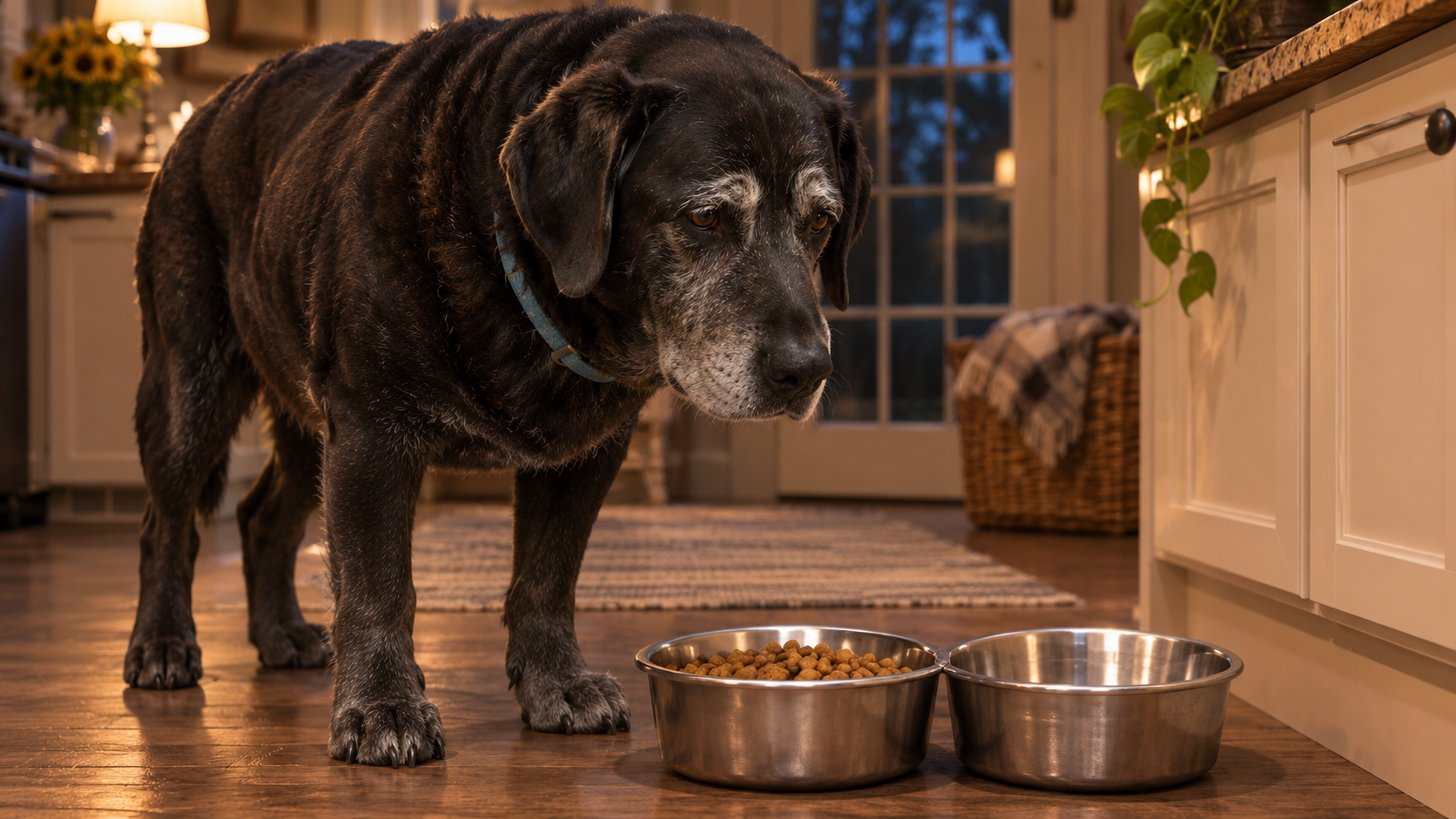
Image source: OpenAI (For illustrative purposes)
In the meeting room, Walter didn’t rush over to me. He walked around its edges, sniffed the corners, then came back to the chair where I sat.
He leaned against my shin with the full, unhurried weight of an old dog.
I scratched behind his ear. His eyes closed.
Nina told me his original family had surrendered him four months earlier after a sudden change in their living arrangements. The information they’d supplied was sparse: he’d lived in a house, knew basic commands, and was generally gentle with people.
The shelter had already checked him over. He had mild arthritis, but nothing in his records suggested the kind of serious illness that would account for the repeated returns.
“He does better when someone is around,” Nina said. “But I don’t want to promise this will be easy.”
I didn’t expect easy.
At the paperwork desk, I noticed a faded navy blanket tucked into his belongings. The shelter had kept it with him because he seemed calmer when it was nearby.
“Can that come home too?” I asked.
“Please take it,” Nina said. “It’s the only thing he always wants in his kennel.”
On the drive home, Walter sat in the back seat with the blanket beneath him. Every time we stopped at a red light, he lifted his head and looked through the window as if trying to recognize the street.
I told him about the little yard, the soft bed waiting in the kitchen, and the walking path around the park.
He listened without looking at me.
That evening, he moved the spare bowl beside his dinner.
I stood watching, certain I was missing something important.
The Strange Routine That Never Changed
Over the next few days, Walter followed a pattern so exact that I could almost set a clock by it.
At breakfast, he sniffed his food and stepped away.
If I carried the bowl into another room, he followed it, then returned to the kitchen. When I put a second empty bowl beside the first, he relaxed enough to eat a little.
At night, he dragged his navy blanket out of his bed and placed it along the wall near the front door.
Sometimes he lay on one side of it, leaving the other half empty.
Sometimes he pressed his nose against the untouched part and gave a single, low whine.
I tried moving his bed closer to mine. I sat with him on the kitchen floor. I offered treats, puzzle toys, and the kind of soft food older dogs are usually delighted to smell.
Nothing changed the routine.
His appetite was inconsistent, so I made a veterinary appointment rather than assuming he was simply sad. The veterinarian examined him, reviewed his shelter records, and discussed his age, mobility, and diet with me.
There wasn’t an obvious medical explanation for the way he arranged the bowls or carried his blanket.
“Big changes can be hard on an older dog,” she said. “Especially when we don’t know his whole history. Give him stability, and keep an eye on his eating.”
I bought a low, comfortable bed and put rugs on the slippery hallway floor. I kept his walks short and slow. I made sure his bowls stayed in the same place.
Still, every evening Walter stood by the front door with that blanket.
It was not the frantic behavior I’d imagined from the shelter’s notes.
It looked like a ritual.
And the empty space beside him looked deliberate.
EVERY NIGHT, WALTER MADE ROOM FOR SOMETHING THAT WASN’T THERE. I DIDN’T UNDERSTAND WHY UNTIL I FOUND A SECOND NAME.
The Name Stitched Into the Blanket
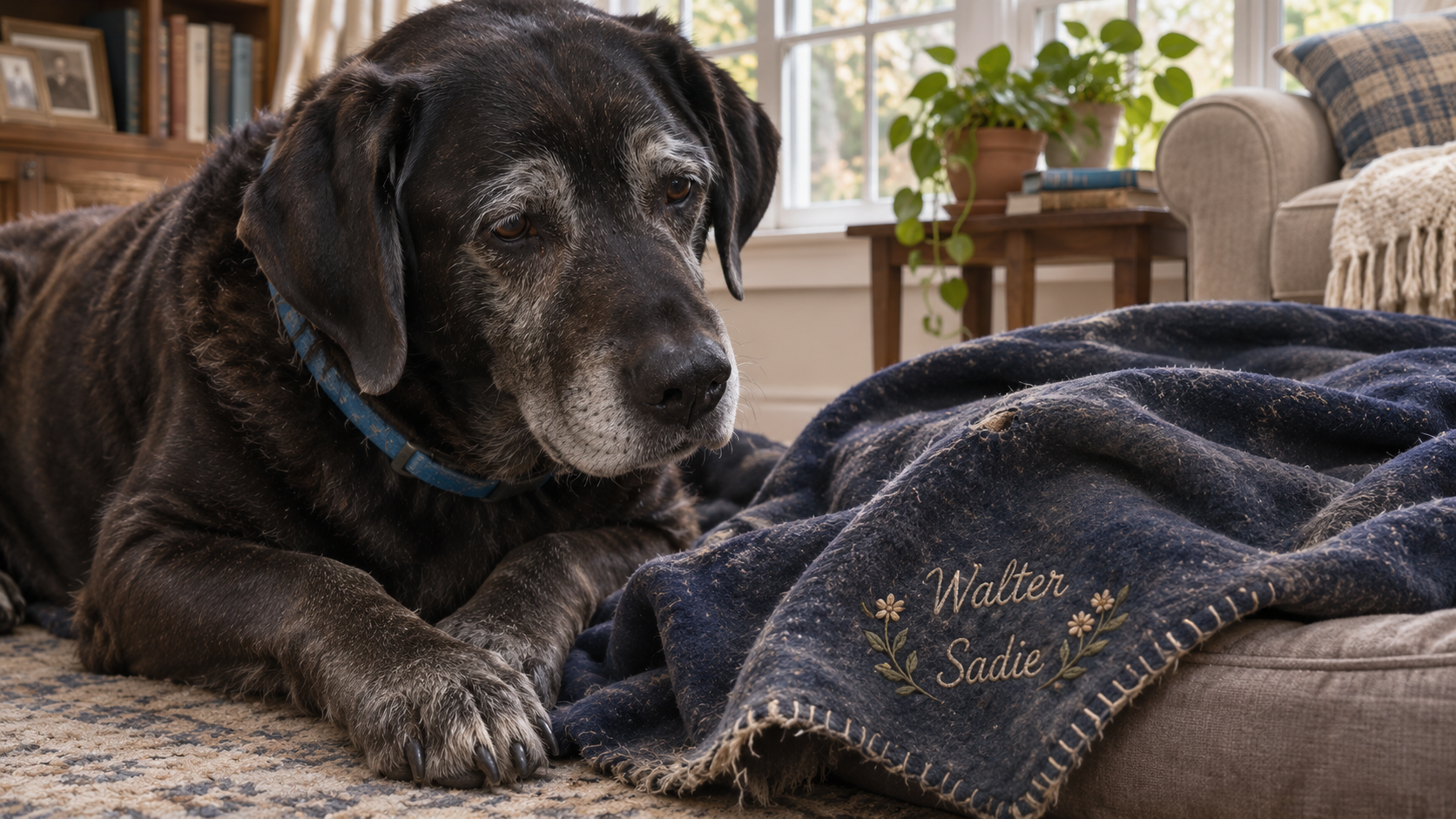
Image source: OpenAI (For illustrative purposes)
On the sixth morning, Walter’s blanket was dirty enough that I decided to wash it.
He watched me pick it up and followed closely to the laundry room. I promised I’d bring it back as soon as it was dry.
As I shook loose the fur and crumbs, one folded corner opened against my hand.
There, beneath a frayed seam, was a line of faded embroidery.
WALTER & SADIE
I stared at the two names.
I’d assumed the blanket belonged only to Walter. The shelter had never mentioned another dog.
Maybe Sadie was a person. Maybe it was a second pet from years ago. Maybe it meant nothing at all.
But when I carried the blanket back into the kitchen, Walter immediately put his nose against the embroidered corner.
He sniffed it for a long time.
Then he settled beside it, making his usual empty space.
I called Nina.
“Was Walter ever in a home with another dog?”
She paused, apparently checking his intake notes.
“It says no other pets in the household. Why?”
I told her about the blanket and the bowls.
“Could the surrendering family have left something out?”
“It’s possible,” she said. “We can try to follow up with them. We shouldn’t guess from a name on a blanket, but this is worth asking.”
For the first time since I’d adopted Walter, someone else seemed as puzzled by his habits as I was.
That night I sat on the hallway floor beside him.
“Who’s Sadie, old man?”
Walter lifted his head at the sound of the name.
I said it again.
He stood so quickly that his hind legs slipped on the rug. Then he walked to the front door, nose raised, and gave a small, hopeful whine.
My stomach dropped.
Whatever Sadie meant to him, it wasn’t a name he’d forgotten.
What His Former Family Hadn’t Said
Nina called the following afternoon.
“I spoke to the people who surrendered Walter,” she said. “There was another dog.”
I sat down at the kitchen table.
“Sadie?”
“Yes. A smaller dog. They lived together for years.”
Walter had belonged to a couple named the Kellers for most of his life. When the couple could no longer keep their home, they moved into temporary housing that wouldn’t allow their dogs.
They’d faced a painful decision with very little time to make it.
Walter was thirteen. Sadie was twelve. She was a small, reddish-brown terrier mix with cloudy eyes and a cautious, quiet temperament.
The Kellers had called several rescue groups, hoping one could take them both. None had immediate space for a pair of senior dogs.
So they surrendered Walter to one shelter and Sadie to another, nearly seventy miles away.
And when Walter’s shelter asked whether he’d lived with other pets, they wrote no.
“Why would they do that?” I asked.
Nina was quiet for a moment.
“They told me they were afraid we’d insist the dogs had to be adopted together. They thought separate listings would give each dog a better chance.”
I looked across the room at Walter, asleep with his chin on the folded blanket.
Three homes had taken him in.
Three homes had tried to make him comfortable.
And none of those families had been told that he might be searching for the dog he’d slept beside for years.
“They should have told you,” I said.
“Yes,” Nina answered. “They should have.”
She explained that the shelters were now trying to locate Sadie. They couldn’t share another organization’s records or the foster family’s contact details without permission, but they could ask the other rescue to connect us.
“I’ll call as soon as I know something,” Nina said.
After we hung up, I sat beside Walter’s bed and stroked the silver fur between his eyes.
“You weren’t waiting for a person to come through the door, were you?”
He sighed in his sleep.
I glanced at the empty half of the blanket.
“You were waiting for her.”
The Dog Who Was No Longer at the Shelter
The next two days were harder than I expected.
I knew Sadie’s name now. I knew roughly where she’d been taken. But I had no idea whether she was still at that shelter, whether she’d been adopted, or whether a reunion would even be possible.
On Thursday, Nina called again.
“Sadie isn’t at the shelter anymore,” she said.
My chest tightened.
“Was she adopted?”
“She’s in a foster home. They’re checking with the foster carer about a meeting.”
I exhaled so sharply that Walter lifted his head from the rug.
“Is she okay?”
“She’s being cared for. There are some things you should know before you meet her.”
Nina explained that Sadie had significant vision loss. She could make out shapes and movement, but she often hesitated in unfamiliar spaces. Her foster carer had been helping her learn where the furniture, water bowl, and doors were.
“She’s very gentle,” Nina said. “But she startles easily when she doesn’t know someone’s nearby.”
I remembered Walter patiently staring at his empty second bowl.
“Did she live like that before?”
“The former family says her eyesight had been getting worse for a long time. We’re hoping to hear more.”
A meeting was arranged for Saturday in a quiet, fenced courtyard at the rescue that was fostering Sadie.
I packed Walter’s blanket, fresh water, his harness, and a small bag of treats.
Then I spent an hour worrying about something I’d never considered when I first brought him home.
What if he didn’t recognize her?
What if she’d changed too much?
What if I’d misunderstood everything?
When Saturday morning came, Walter climbed carefully into the back seat and settled on his blanket.
He looked out the window as we started down the highway.
This time, I knew what I was hoping he would see.
The Meeting in the Quiet Courtyard
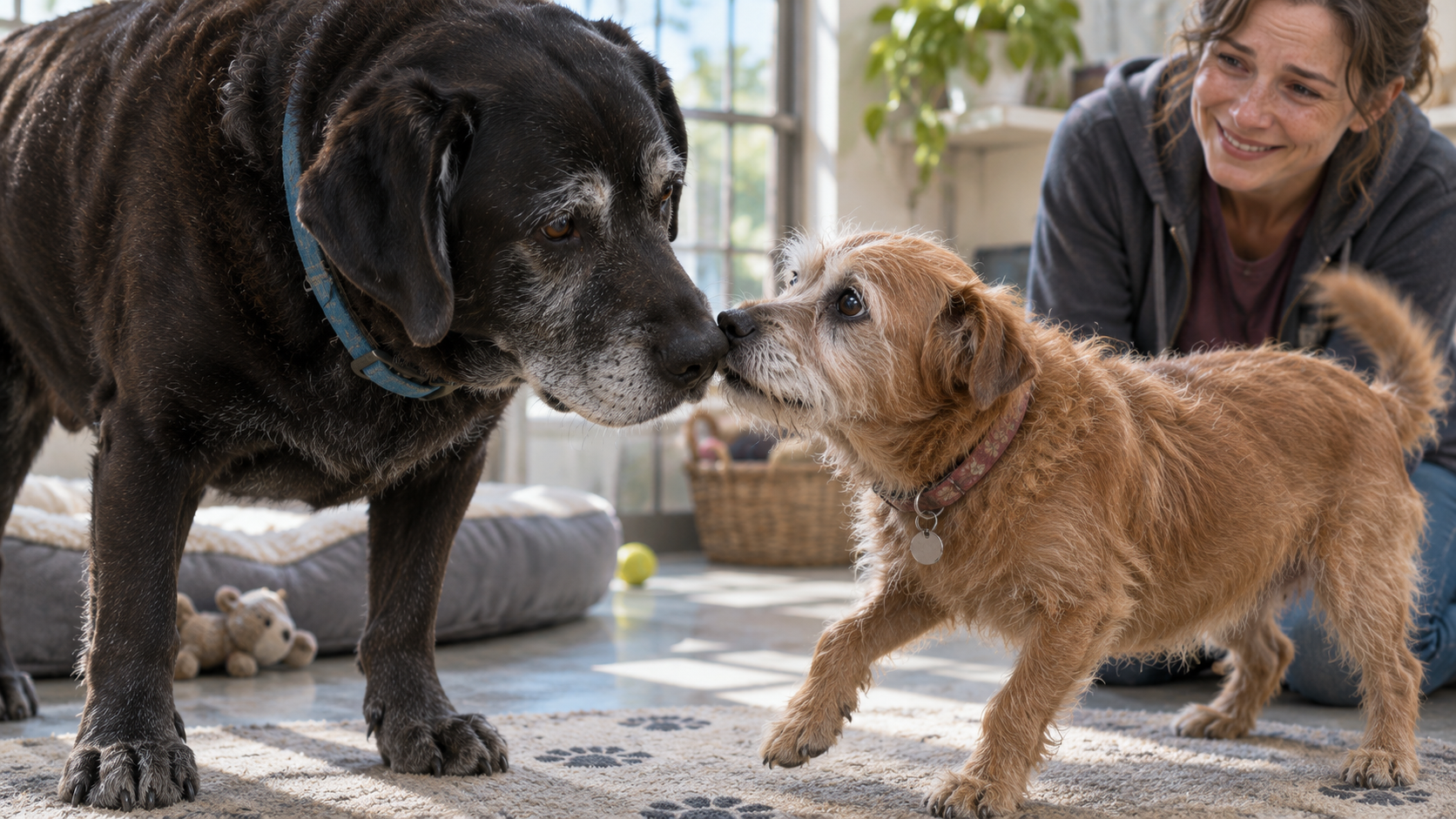
Image source: OpenAI (For illustrative purposes)
Sadie’s foster carer, Grace, met us at the rescue gate.
“We’ll go slowly,” she said. “They’re both seniors. We’ll let them decide how close they want to be.”
Walter walked into the courtyard on his leash. He stopped to sniff a patch of grass, then turned toward a faint clicking sound on the far side of the yard.
Grace had opened another gate.
A little reddish-brown dog stepped through with a volunteer beside her. Her muzzle was almost completely white. She paused after three steps, tilting her head and sniffing the air.
Walter went still.
I’d seen him alert to footsteps, doors, and passing dogs during our walks. I’d never seen his entire body change like that.
His ears lifted. His tail began to move, slowly at first.
Then he walked toward Sadie with a steadiness I hadn’t seen since adopting him.
Grace guided Sadie closer. She stopped, raised her nose, and sniffed Walter’s face.
For a moment, nothing happened.
Then she pressed her cheek gently against his neck.
Walter leaned into her.
There was no wild jumping, no dramatic barking, no spectacle. They were old dogs, tired from too many unfamiliar places.
They simply stood together, touching shoulders, as though something that had been out of place was finally where it belonged.
I began to cry.
Grace smiled through tears of her own.
“Well,” she whispered. “I think they remember.”
We walked them around the courtyard side by side. When Sadie paused near a bench, Walter slowed automatically and waited for her. When she drifted toward a planter, he turned and stood close until she found the path again.
It was such an ordinary little movement that I almost missed it.
Then I saw him do it again.
For weeks, I’d been trying to figure out why Walter always waited beside an empty space.
Now I was watching him wait for Sadie.
WALTER DIDN’T RUN TO HER. HE WALKED UP, STOOD STILL, AND LET HER FIND HIM. THEN HE WAITED WHILE SHE FOUND HER WAY AGAIN.
The Second Thing They Hadn’t Told Us
After the meeting, Grace showed me some notes from Sadie’s foster home.
Sadie had been eating, but she’d been reluctant to approach her bowl unless someone guided her close. She seemed most comfortable sleeping against a rolled blanket or the side of a couch.
That sounded painfully familiar.
Nina had contacted the Kellers again, and this time they’d spoken more openly about the dogs’ life together.
As Sadie’s eyesight faded, Walter had developed a routine around her.
At mealtimes, he’d wait until she reached her bowl before eating from his own. At night, they slept shoulder to shoulder on their navy blanket. Outside, he often paused when she stopped and stayed near her until she caught up.
No one had formally trained him to do it. The Kellers simply said he’d started helping her in small ways and kept doing so.
“They thought separating them would make adoption easier,” Grace said. “But they didn’t understand how much their routines depended on each other.”
I thought of the two bowls on my kitchen floor.
Walter had not been refusing food to be difficult.
He’d spent years eating beside Sadie. In a strange house, surrounded by strangers, he was still looking for the part of dinner that had gone missing.
I thought of him dragging the blanket to the door every evening.
He hadn’t been trying to ruin another family’s home.
He had been making room for his best friend.
“Would they let me adopt her?” I asked.
Grace studied me carefully.
“Adopting one senior dog is a commitment. Two can mean more veterinary care, more time, and adapting your home for Sadie’s sight. We’d want to be sure it’s right for all of you.”
Making Room for Both of Them
I nodded.
“I understand. I want to do it properly.”
There was paperwork, a veterinary review, and another visit. I asked questions about Sadie’s eyesight and how to help her move confidently through my house. I rearranged the furniture, added rugs, and made sure the garden gate latched securely.
I didn’t want to rescue a beautiful moment and then discover I wasn’t prepared for the ordinary days afterward.
A week later, the rescue approved Sadie’s adoption.
Walter would not be coming home alone.
WALTER HAD BEEN RETURNED THREE TIMES BECAUSE HE KEPT WAITING. NOW I FINALLY KNEW WHAT HE NEEDED BEFORE HE COULD SETTLE.
The Home They Finally Shared
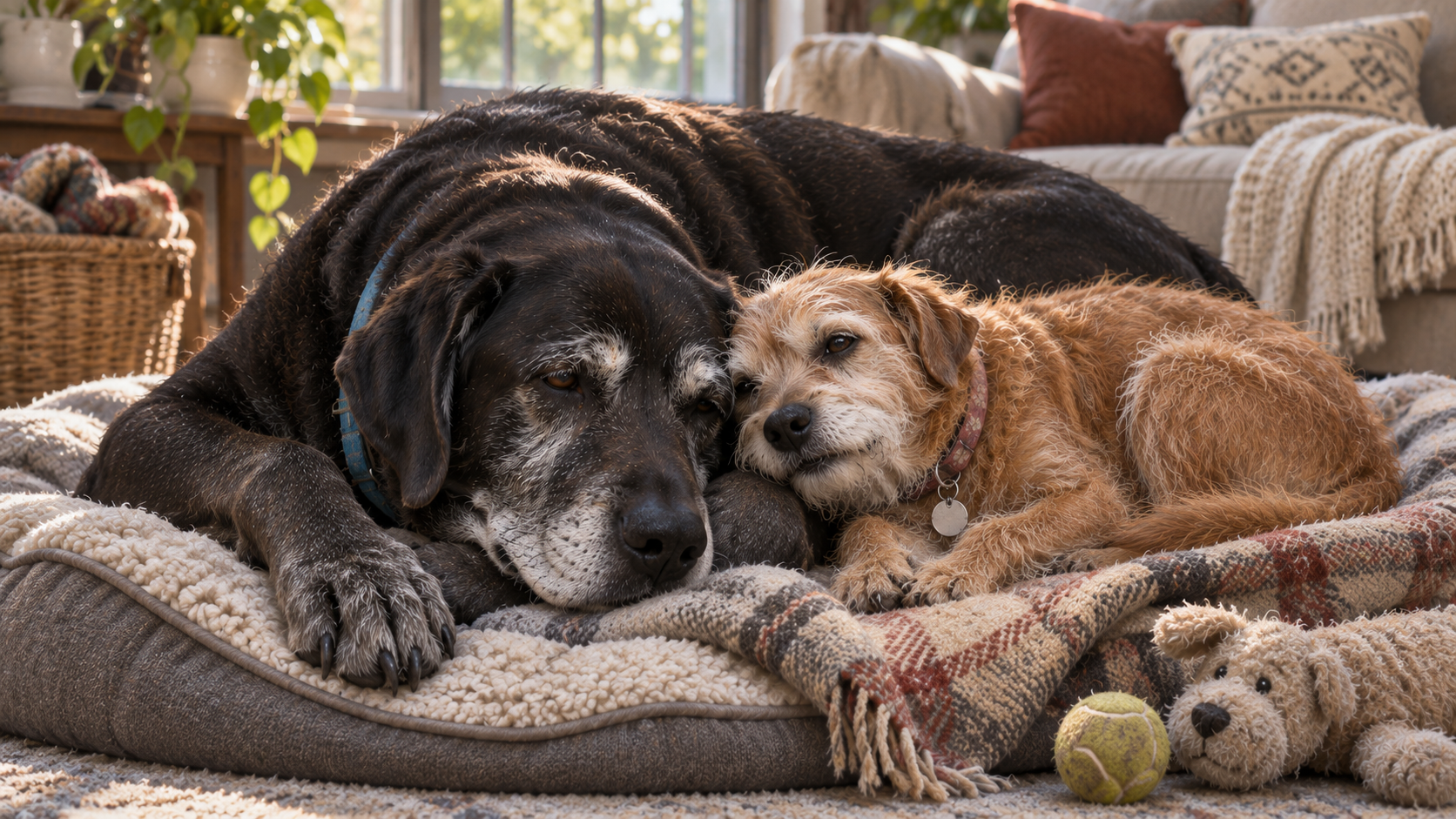
Image source: OpenAI (For illustrative purposes)
When Sadie arrived, I placed two beds beside each other in the living room.
I set two water bowls against the wall where she could find them easily, and I kept the walkways clear.
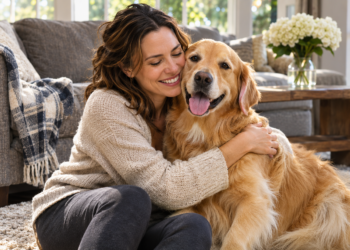
Walter walked beside her as she explored. When she stopped at the edge of a rug, he stopped too. When she reached his old navy blanket, she sniffed it and lay down.
Walter curled up beside her.
That evening, I prepared dinner just as I had every night since Walter came home.
I put his bowl down.
Then I placed Sadie’s bowl beside it, with space between them so they could eat comfortably.
Walter looked at his food, looked at Sadie, and waited.
She sniffed her bowl. I guided her gently to the right spot, as Grace had shown me. She took a bite.
Only then did Walter lower his head to eat.
I stood in the doorway and watched both bowls empty for the first time.
The next morning, he didn’t pace the hallway. He didn’t scratch at the front door. He didn’t drag the blanket away from his bed.
That didn’t mean every problem had vanished. Walter still needed help with his stiff legs. Sadie still needed a predictable layout and careful supervision in unfamiliar places. There would be medical appointments, slow mornings, and hard decisions that came with loving older dogs.
But the strange, aching ritual that had followed Walter through three failed adoptions had finally changed.
A month later, Nina sent me a photo she’d taken of Walter at the shelter, before I’d met him.
He was lying alone on that faded navy blanket, his head resting on one empty corner.
Under the photo she wrote: I’m so glad someone asked what he was waiting for.
I looked across my living room.
Walter was asleep, his gray muzzle resting beside Sadie’s paws. She was curled against his shoulder. Their breathing rose and fell in different rhythms, but neither seemed troubled by the space around them.
I used to think a returned dog was a dog who couldn’t make a home work.
Walter taught me something different.
Sometimes a dog isn’t asking for a different home.
Sometimes he’s asking you to find the piece of his old one that never should have been taken away.
And for Walter, that piece had a name.
Sadie.
An original fictional story. The characters and events are invented.