
At 6:31 on a Saturday morning, something scraped against my front door hard enough to wake me.
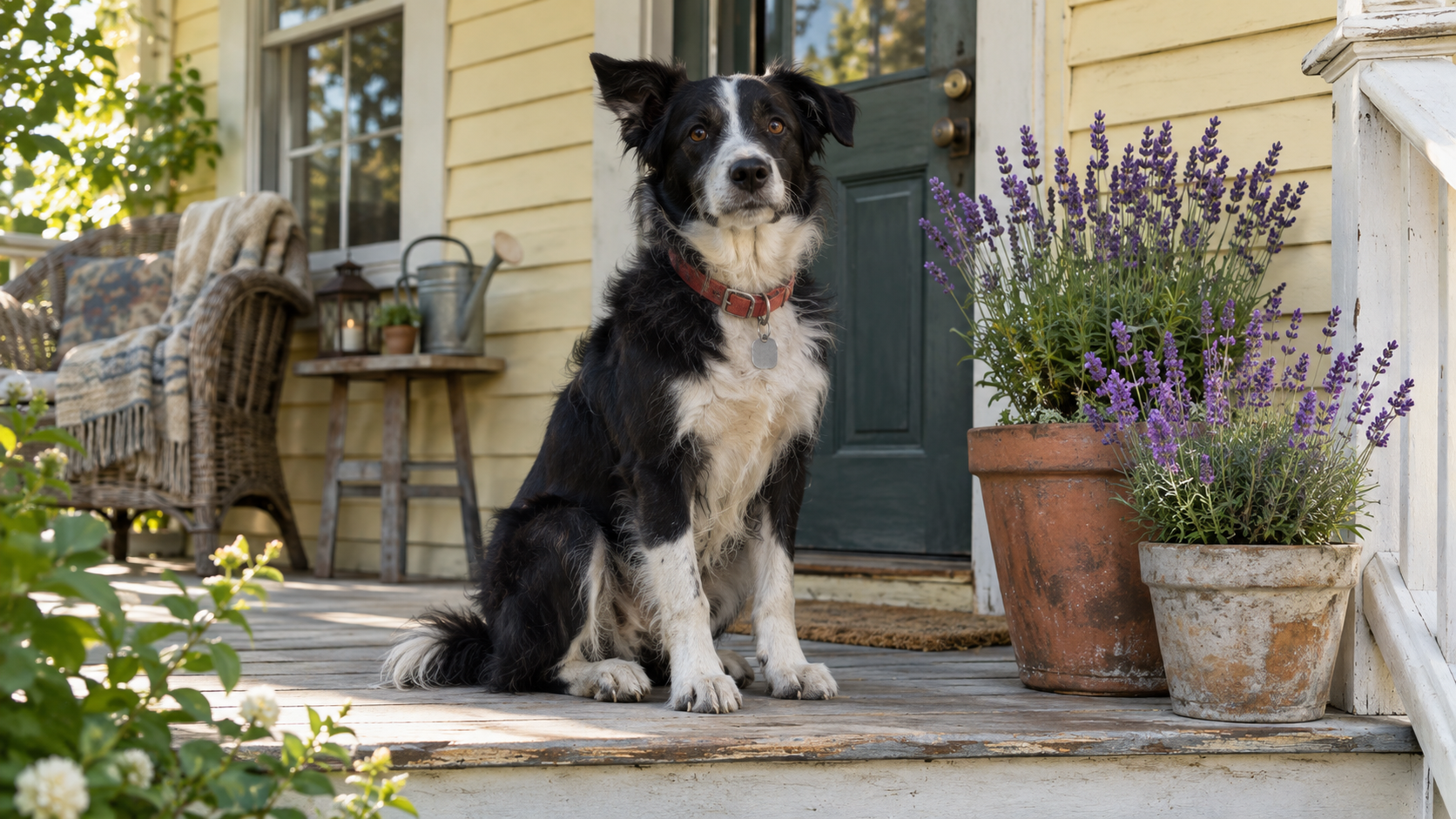
When I looked through the glass, the same black-and-white dog who had been visiting my porch for nearly two weeks was standing on the top step. This time, though, he wasn’t sitting patiently beside the flowerpot.
He was shaking. A red leash dangled from his mouth, and he kept turning toward the street as though he wanted me to follow.
I’d finally managed to read the back of his collar tag three days earlier. Until then, I’d thought he was simply a friendly neighborhood dog with a peculiar routine.
Now I knew exactly why someone had put those words on his tag.
I grabbed my shoes, took my phone, and went outside.
I didn’t know whether the person named on that little piece of metal was in trouble. But I knew I couldn’t ignore the dog again.
HE’D BEEN COMING TO MY PORCH EVERY MORNING. THIS WAS THE FIRST TIME HE’D ASKED ME TO COME WITH HIM.
The Visitor at 7:14
The first time I saw him, I assumed someone had let their dog out for an early walk.
It was a Tuesday, five months after I’d moved into the pale-yellow house on Cedar Lane. I was watering the two pots of lavender beside my front door when a medium-sized dog appeared at the bottom of the steps.
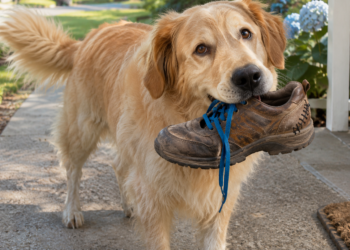
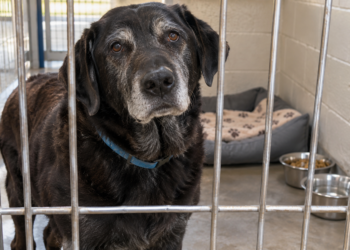
He had a black coat, a white chest, one white front paw, and a small patch of brown above his left eye. His ears were uneven: one stood almost straight while the other folded at the tip. A faded red collar showed beneath his thick fur.
He walked up the steps, sat beside my empty flowerpot, and watched the door.
“Hello,” I said. “Are you lost?”
He didn’t bark or jump at me. He just gave one slow wag of his tail.
I brought him a bowl of water. He took a few laps, but when I offered him a dog biscuit left over from a friend’s visit, he ignored it.
After perhaps ten minutes, he stood, looked once toward the corner, and trotted away.
I watched him disappear past the hedges and thought nothing more of it.
The next morning, I opened my door to take out the recycling and found him in the exact same place.
I looked at the clock on my phone.
7:14 a.m.
“Are we doing this every day?” I asked.
He wagged his tail, sat down again, and stared through the open doorway as if someone ought to be standing behind me.
He Never Asked for Food
By Friday, I had a routine I hadn’t agreed to.
I made coffee, opened the front blinds, and looked for the dog. He usually arrived between 7:10 and 7:15. He always used the same three steps, and he always sat beside the flowerpot, facing the front door.
If I didn’t come outside, he’d wait a while and leave.
He was clean and well fed. He didn’t seem frightened. He wore a collar, though the tag was usually hidden beneath the heavy fur around his neck.
I took a photograph and shared it in our neighborhood group: Does anyone know this dog? He stops by my porch every morning.
The replies were mostly guesses. One person said she’d seen him near the small park two streets over. Another thought he belonged to an older woman on Willow Court. Nobody gave me a definite answer.
I set out water again. He drank it. I offered a little food. Again, he wasn’t interested.
What bothered me was the way he studied the doorway.
Sometimes he would stand, take two steps toward the hall, and then sit back down. Once, when I moved aside, he leaned forward and sniffed the old wooden threshold, concentrating so hard his tail stopped moving.
Then he’d look up at me with what I could only describe as disappointment.
I knew that was a human feeling to put on a dog. Still, the expression stayed with me.
The following Monday, it rained. I opened the door at 7:14 and found him sitting on the wet steps, water beading along his back.
“Come on, sweetheart,” I said, holding the door wider.
He stepped inside just far enough to put his nose against the leg of the narrow bench in my entryway.
Then he turned around and walked straight back out.
He had come for something. I just couldn’t tell what it was.
The Words Under His Collar
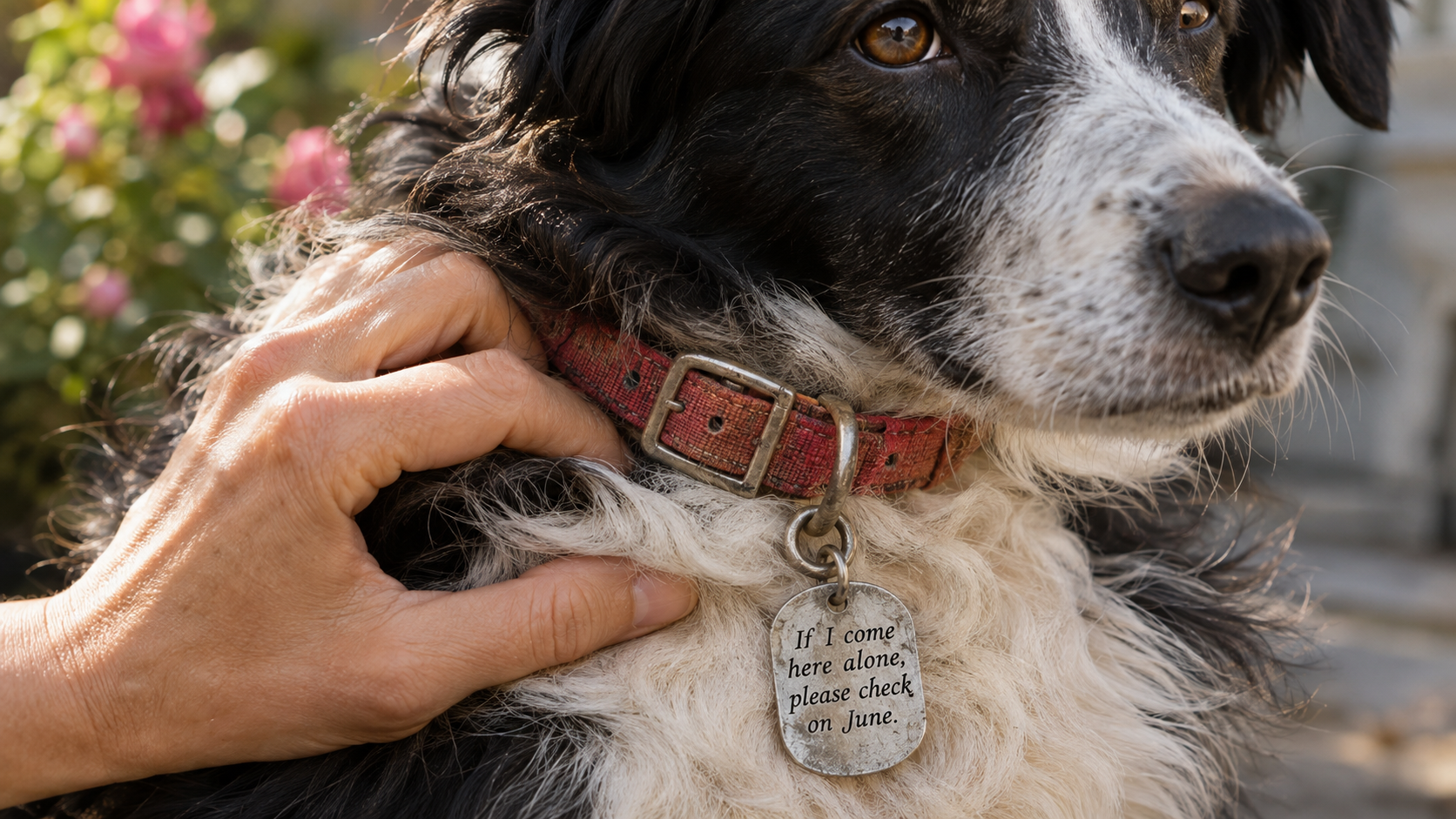
Image source: OpenAI (For illustrative purposes)
On the eighth morning, he finally let me get a proper look at his tag.
He had been sitting beside me while I drank coffee on the step. When I scratched the fur behind his folded ear, he leaned his weight against my knee and closed his eyes.
His collar shifted. A small round metal disc swung free.
The front said SCOUT in neat stamped letters. Beneath it was an old telephone number, but the final two digits had been worn almost smooth.
I turned the disc over.
On the back, in smaller lettering, were two lines that made me stop stroking his ear.
IF I COME HERE ALONE, PLEASE CHECK ON JUNE.
19 WILLOW COURT.
I read it twice.
Not If found, call my owner. Not I am friendly.
If I come here alone, please check on June.
The wording sounded less like an ordinary dog tag and more like instructions left for one particular doorstep.
I looked from the tag to my house. Scout was sitting quietly, as though he’d been waiting for me to understand.
I grabbed my phone and searched the address. Willow Court was only four blocks away.
“Is June your person?” I asked him.
Scout stood immediately.
I went inside, pulled on my sneakers, and took the leash I kept in the hall for visiting dogs. He let me clip it to his collar without protest.
When we reached the sidewalk, he turned toward Willow Court before I had said a word.
THE TAG DIDN’T SAY WHERE TO RETURN HIM. IT TOLD ME TO CHECK ON SOMEONE.
The House on Willow Court
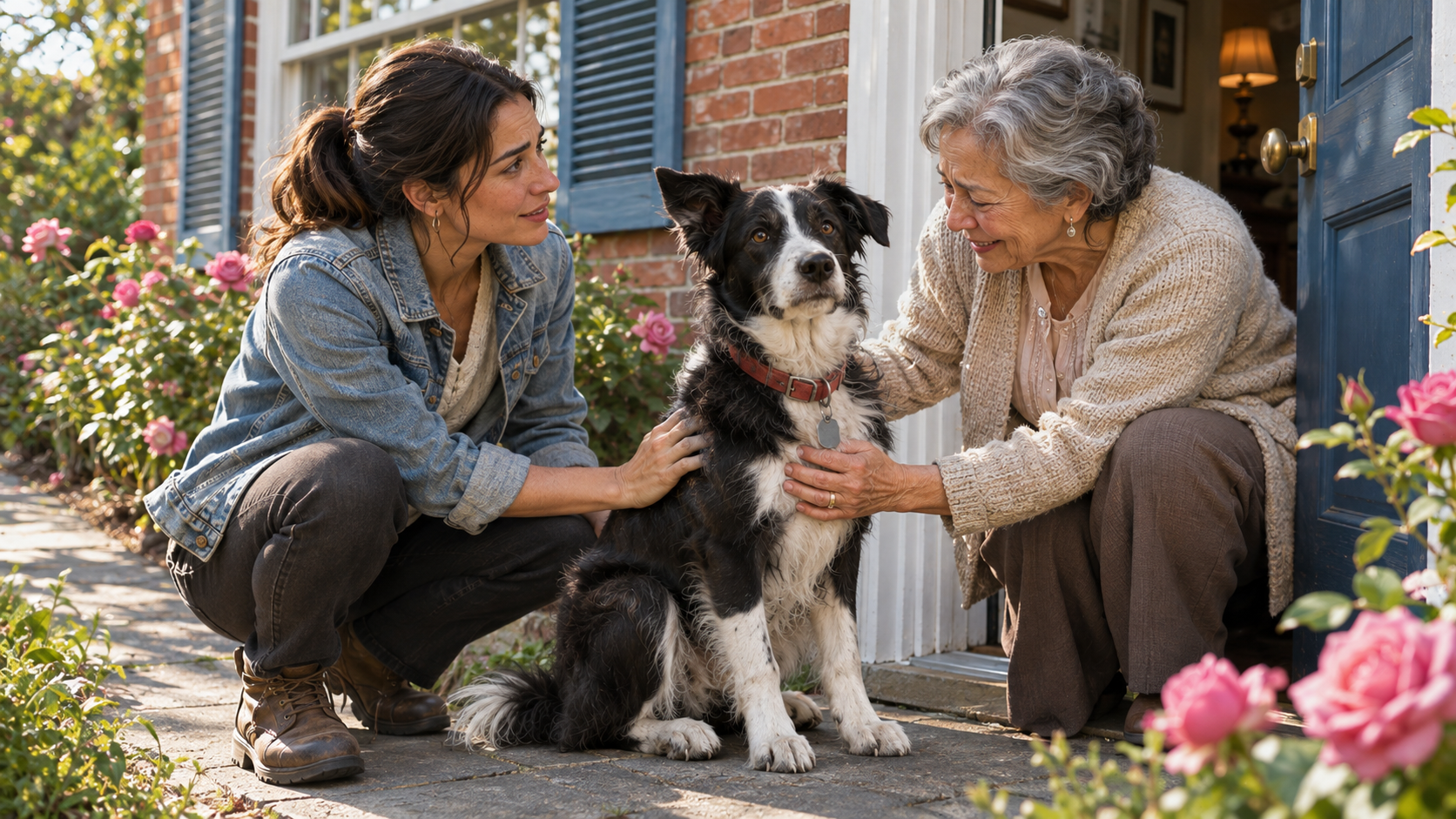
Image source: OpenAI (For illustrative purposes)
Number 19 was a small brick house with blue shutters and rosebushes growing along the front path.
Scout hurried to its side gate, then stopped and waited while I knocked at the front door.
I knocked again.
No answer.
For a moment, my stomach tightened. I remembered the tag and wondered whether I’d already waited too long.
Then I heard a woman’s voice behind the door.
“Just a minute! I walk slower than I used to.”
A woman in her seventies opened it. She had silver hair cut short around her ears, an oversized green cardigan, and the mildly annoyed expression of someone interrupted before breakfast.
The moment she saw Scout, her face softened.
“There you are,” she said. “I wondered where you’d got to.”
Scout leaned against her legs, his tail beating softly against the doorway.
“I’m sorry to bother you,” I said. “He keeps coming to my porch on Cedar Lane. I read his tag, and I wanted to make sure you were okay.”
The woman looked up sharply.
“Cedar Lane? Which house?”
“The yellow one. Twenty-six.”
She gripped the edge of the open door.
“Oh,” she said. “Ruth’s house.”
Her eyes filled so suddenly that I didn’t know what to do with my hands.
She introduced herself as June Navarro and invited me in for a moment. Scout walked into the kitchen, drank from a bowl beside the refrigerator, and settled at her feet.
June explained that she sometimes let him into the enclosed side garden after breakfast. The old wooden gate had a latch he could nose open if it wasn’t set properly. She had assumed he was stretching his legs in the garden, not walking four blocks across the neighborhood.
“I thought he was getting too old for adventures,” she said.
“Apparently not,” I answered.
She managed a smile, then looked back at me.
“Does he still sit on the top step?”
I nodded.
June put a hand over her mouth.
The Woman Who Used to Live Here
Ruth Bennett had lived in my house for thirty-one years.
I knew the name from paperwork I’d signed at closing, but very little else. The house had been sold by her estate after she died the previous winter.
June told me Ruth had been her closest friend.
They had met when their children were small, become neighbors, and kept visiting each other long after the children moved away. Even after June moved to Willow Court, Ruth’s porch remained part of their morning routine.
At 7:15, June would walk over with Scout. Ruth would be waiting with tea, and Scout would sit beside the flowerpot until she opened the door.
“He never wanted a biscuit first,” June said. “He wanted to see Ruth. She always rubbed that silly folded ear of his.”
I thought of the way Scout leaned into my hand when I touched that ear, and I had to look down at my coffee.
After Ruth died, June stopped making the walk. The route was harder on her knees, and she couldn’t bear looking at her friend’s empty porch.
But Scout, it seemed, hadn’t stopped visiting.
“He must think if he keeps coming, she’ll be there,” June whispered.
I wanted to say that dogs didn’t think about things quite like people did. But I didn’t know what Scout understood. I only knew what I’d seen: eight mornings of a dog waiting quietly at an old friend’s door.
“Why does his tag tell people to check on you?” I asked.
June gave an embarrassed laugh.
“That was Ruth’s idea.”
Four years earlier, June had fallen in her kitchen while home alone. She was eventually found unharmed, but the experience scared both women. Ruth made June promise to carry her phone and let family know when she needed help.
Then Ruth took Scout to have a new tag made.
“She said if I ever couldn’t come out, he might still come looking for her,” June said. “And she wanted whoever opened her door to know what to do.”
For years, that person had been Ruth.
Now it was me.
A Promise I Didn’t Know I’d Made
I stayed for almost an hour that morning.
June showed me a photograph on her refrigerator of two women standing in front of my yellow house. One held a teapot. The other, younger than the woman sitting across from me, had an arm around Scout.
The lavender pots in the photograph were the same ones beside my front steps.
“Ruth planted those,” June said. “She said the porch needed something alive even in winter.”
Before I left, we exchanged phone numbers. I offered to send June a message if Scout ever came back, and she promised to have the side gate repaired.
She also called her daughter Naomi, who lived about forty minutes away, and told her Scout had been taking himself on morning visits again.
When I returned home, I looked at the entryway bench Scout had sniffed in the rain. Ruth had left it with the house. I hadn’t thought much about it before.
Now the bench, the lavender, and the worn threshold felt like pieces of a conversation that had continued after one person was gone.
The next morning, Scout didn’t appear.
Neither did he the morning after that.
I assumed June had kept him safely indoors while she waited for the gate repair. I was relieved, but the empty step looked oddly bare.
On Friday, June sent me a photo of Scout asleep on her kitchen rug.
He’s staying home like a good boy, she wrote. Thank you for coming over the other day.
I responded with a heart and went back to work.
I thought the story was over.
It wasn’t.
Forty Minutes Too Early
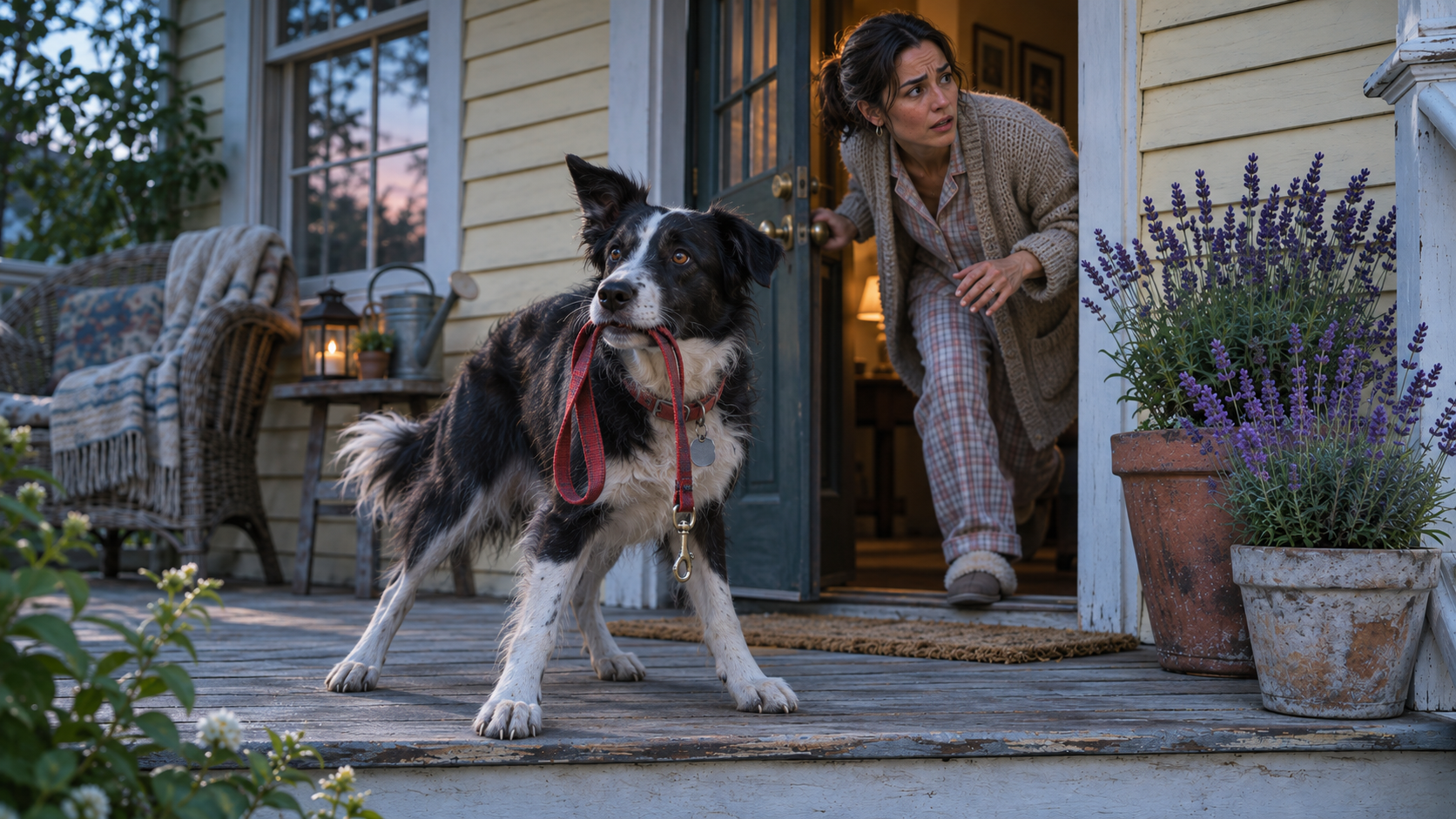
Image source: OpenAI (For illustrative purposes)
At 6:31 on Saturday morning, I heard scratching at my front door.
I pulled back the curtain.
Scout was on the porch, but everything about him was different.
He wasn’t sitting beside the flowerpot. He was pacing between the door and the top step. His red nylon leash hung from his mouth, dragging across the boards.
When he saw me, he dropped it, picked it up again, and pressed his nose against the glass.
“Scout?”
His tail wasn’t wagging. His ears were pinned back, and his breathing was quick.
I opened the door. He backed away two steps, turned toward the street, then came straight back to me.
He repeated the movement, over and over.
I remembered Ruth’s words on his tag.
If I come here alone, please check on June.
I called June’s number. It rang until the voicemail answered.
I tried again.
Nothing.
The difference between an ordinary morning and this one suddenly seemed enormous.
I clipped the leash to Scout’s collar, threw on a jacket over my pajamas, and followed him down the steps.
He didn’t stop to sniff a tree or investigate a driveway. He went directly toward Willow Court, occasionally looking back to make sure I was coming.
I walked as fast as I could.
SCOUT HAD NEVER BROUGHT HIS LEASH BEFORE. THIS TIME, HE WOULDN’T LET ME STAY ON THE PORCH.
The Door Nobody Answered
June’s front curtains were closed when we arrived.
Her newspaper was still on the front walk. The porch light, usually switched off by breakfast, was burning in the morning sun.
I rang the bell.
No answer.
“June? It’s Maya, from Cedar Lane!”
I knocked hard enough that my knuckles stung.
Scout pulled toward the side of the house. The old garden gate was standing slightly open, its loose latch still unrepaired. That was how he had gotten out.
I called June’s daughter, Naomi, using the number June had given me. She answered on the second ring.
“I think something’s wrong,” I told her. “Scout came to my house with his leash. June isn’t answering.”
Naomi’s voice changed.
“I’m leaving now. Please call emergency services.”
I did. I explained that an older woman appeared to be alone, wasn’t responding, and that her dog had come to alert me. The dispatcher asked questions and told me to stay on the line and follow their instructions.
Scout stood near the side door, looking toward the kitchen. He didn’t bark. He just kept shifting his weight, making a small, breathy sound.
The emergency crew arrived a few minutes later. After checking the doors and assessing the situation, they entered the house.
I waited in the garden with Scout beside me.
Then one of the responders came out and told me they had found June on the hallway floor. She was conscious, but weak, and needed medical care.
My knees felt unsteady with relief and fear at the same time.
As they helped June out, she saw Scout and reached a hand toward him.
“There you are,” she said faintly.
Scout pressed his nose against her fingers.
When the ambulance doors closed, Naomi was still on her way. I promised her over the phone that I would keep Scout safe until she arrived.
For the second time that week, he came home with me.
This time, he came inside.
What Ruth Had Taught Him
June spent several days recovering. Her doctors expected her to improve, and Naomi arranged for extra support at home while they worked out what she needed.
Scout slept beside my sofa the first night. Every so often he lifted his head and looked toward the front door.
On Sunday afternoon, Naomi stopped by to collect a change of clothes for her mother. She brought a small cardboard box from June’s kitchen cupboard.
“My mom asked me to show you this,” she said.
Inside were two old photographs, a handwritten note, and a faded red leash with a patch sewn into the handle.
The note was in Ruth’s handwriting.
We practiced again today. Scout knows the way from June’s house to my front step. If he ever comes to the door carrying his leash without June, I’ll go straight over. No biscuits first.
There was a date at the bottom from four years earlier.
I read the note again, then looked down at the red leash Scout had carried to my porch.
Naomi told me Ruth and June had treated it like a little game. During their morning visits, Ruth would occasionally ask Scout to carry his leash to the porch. When he arrived, she would praise him, clip it on, and walk with him back to June’s house.
They hadn’t known whether such a habit would ever help in a real emergency. Ruth had simply wanted him to remember one place where someone would notice him.
“She worried about Mom being alone,” Naomi said. “I think they both did.”
I thought about Scout waiting quietly on my steps for those earlier mornings.
He hadn’t been warning me every day. He’d been returning to a familiar place, hoping to find a person he missed.
But when something really was wrong, he had done more than visit.
He’d brought the leash.
And, somehow, he’d known I was the person standing behind Ruth’s old door now.
THE TAG WAS RUTH’S BACKUP PLAN. THE LEASH WAS THE SIGNAL SHE HAD TAUGHT HIM TO USE.
The Porch Light We Left On
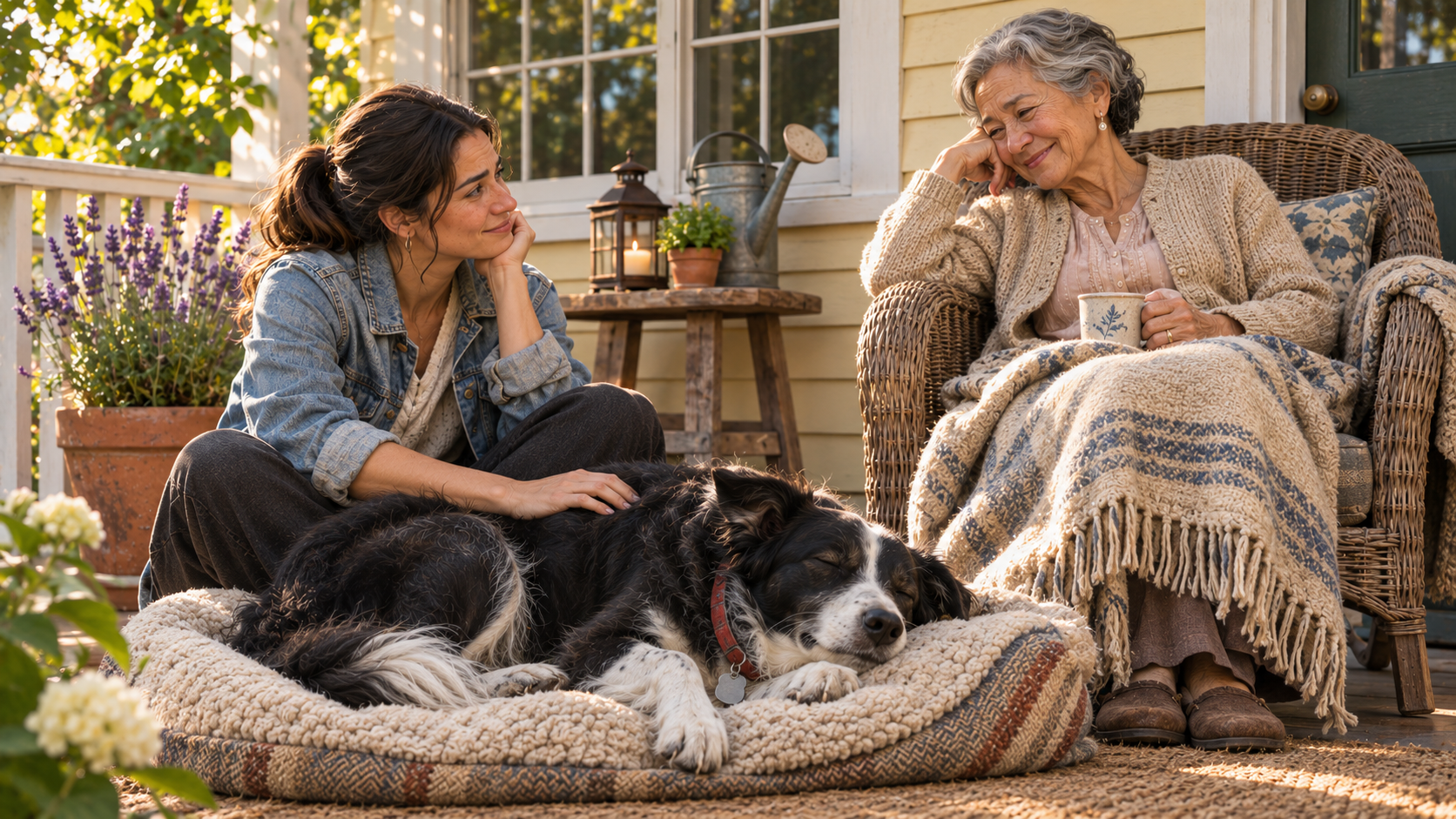
Image source: OpenAI (For illustrative purposes)
June came home the following week.
Naomi arranged regular check-ins and worked with her mother on a safer plan for getting help if she needed it. The garden gate finally got a new latch. Scout’s tag was replaced with one that had current phone numbers and June’s address, plus a clear emergency contact.
I was glad they changed it, even though I felt unexpectedly sad watching Ruth’s old tag disappear into a kitchen drawer.
June noticed.
“Keep it,” she told me. “Ruth would like that.”
A few days later, Naomi invited me over for tea. June was sitting in her favorite chair, a blanket across her knees. Scout lay beside her, looking entirely pleased with himself.
“I owe you an apology,” June said as soon as I sat down.
“For what?”
“For not telling you he’d been visiting Ruth’s porch. I should have checked where he was going.”
“I probably should have read his tag the first day,” I said.
June shook her head.
“We both know now.”
We sat quietly for a while. Then she brought out the photograph of the two women in front of the yellow house and told me more about Ruth: the way she saved handwritten notes from friends, how she hated throwing away teacups, how she never let Scout leave without a last scratch behind his crooked ear.
By the time I went home, the house I’d bought felt different again. It still belonged to me, but it carried a friendship I’d inherited without knowing it.
Scout no longer wandered over by himself. Instead, on Tuesday mornings, I walked to June’s house and took him out with her permission. Sometimes June joined us for a short stroll. Sometimes I brought tea and sat with her until she was tired.
On our way back, Scout would still stop in front of my porch.
He’d look at the lavender pots, climb the steps, and sit beside the same flowerpot he’d chosen on that first morning.
I would open the door and scratch the fur behind his folded ear.
And then we’d head home together.
I used to think he was a dog who didn’t know where he belonged.
Now I understood that he had known exactly where to go all along.
He’d gone to the porch where somebody once promised to listen.
And when he needed help, somebody finally did.
An original fictional story. The characters and events are invented.